After two days of sun, we loaded our bikes, navigated the outskirts of Arequipa and ascended gradually into the high mountain storms of Southern Peru.
So… does anyone have any questions? I know we did. Before Lima, life was: born daycare school internship job retirement. After Lima, life is more like: born daycare school hey look at that shiny thing over there.
Yes, you, in the back. Sorry, can you speak up? Was it warmer at least? Actually, fun fact, it was colder. What’s that? Why exactly did we take a 19-hour bus from Lima to Arequipa? Good question. Well, that’s all the time we have for today.
We were already purple-lipped and shivering when, through the fog, we glimpsed a muddy tunnel. Or as Ceci would call it: un puente. We were quiet as we ducked into the relative shelter it offered. When, matter of fact and with practised efficiency, we pulled our rain-pants on, it felt like we were re-embodying ourselves, one leg at a time. Slipping back into our own shed skin. It felt both wrong and familiar. Like knocking on the door of an abusive ex. A part of us muttering under our breath, why are we doing this? Also, a part of us yearning to slide back into the familiar rut, if only to avoid the misery of uncertainty. Farewell roller-coaster of hope and disappointment, excuse us as we go back to accepting the life-sucks-sometimes-ness of life. Don’t mind us as we lower our heads and suffer the numbness back into our bodies, the zombie-gaze back into our eyes…
Shivering in silence, we ate a snack on the edge of the tunnel. Watching the rain pour and pour, while the last vestiges of heat drained out of our souls. Ceci asked if she could push on. I said yes and stayed back, eyeing the rain a little longer. It’s the dramalessness that breaks my heart. Time and time again. At some point it just went from ‘Our Suffering’ being the elephant in the room — neither of us wanting to make it realer by mentioning it; to the elephant being the room. A matter so beyond discussion, it never occurred to us to speak of it. What does it matter if the elephant skin is blue or pink when we have to move sloppy elephant entrails aside every time we hand each other a cookie or a dropped glove? It’s simply a fact of life inside an elephant that internal organs get in the way.
It breaks my heart, of course, the knowledge of just how crooked life has gotten if crying and… and numb hands and purple lips and 11-hour days are no longer worthy of note. Just the colour of the skin of the elephant room. But when my heart breaks, it does so in silence. Without drama or energy expenditure. What good the knowledge that it has not always been so? We put it out of our minds. Better to forget all about life outside of the elephant. Of a time when fighting against kilometres of intestines just to give one another a hug was so unthinkable that we could not even think about thinking it.
But we can’t, can we? And as soon as we try, knowing, itself, becomes the elephant in the elephant room. Imagine sharing the insides of an elephant with an elephant; wouldn’t you suddenly find it impossible not to talk about that elephant? Wouldn’t you want to talk about it precisely to make it realer? Yes, you would.
And the thing is, there is a certain beauty to how absurd things have gotten. Of course, beauty is in the eye of the beholder. Were you to crack my eye open like an egg and look inside, you’d find that contrast is the beauty I most enjoy. My eye can somehow contain both the yolk of ‘Life inside an elephant’ and the egg-white of ‘Remembering life outside the elephant’. The trick is to resist the urge to scramble both together. The beauty of Yin Yang is how it contrasts. Who wants to look at a grey circle? And yet, if we don’t consciously endeavour to maintain the equilibrium, that’s what the mind does. It fudges. It scrambles. And soon, everything is grey. All the components are there. But not in a beautiful way, you see? Scrambling is a defence mechanism against the relentless nuance of life. Because the trouble with an unscrambled eye is that to constantly see such contrasts breaks your heart.
Yes, it’s a heartbreaking sort of beauty, but here’s the heartbreaking beauty of heartbreaking beauty: the beauty itself is the glue that mends the broken heart back together. That’s why it hurts. But in a good way. Like tears of joy. I know it’s all a bit wabi-sabi, but trust me, when you spend enough time inside an elephant, it’s the concept of perfection that becomes absurd. Laughable. Although I’m not laughing now.
The rain outside the tunnel pours and pours. When I turn towards the other end of the tunnel, I can just make out Ceci, a black dot silhouetted against the light at the end of the tunnel. When she asked me if she could start riding through the tunnel before she froze to death, she said it wrong. Puente means bridge. Not tunnel. Do you know how many tunnels we rode through on the trip, so far? Somewhere between two dozen and a hundred. And every time, without fail, she says Puente instead of Túnel.
Which is funny to me because, were you to ask me which one Ceci is, whether a tunnel or a bridge, I would have to say tunnel. I’m the bridge. I always seek to finesse my way over and around obstacles. I believe misadventures will happen no matter what, so why go looking for them? Ceci is the one who plows through. Who puts her head down and plows through solid stone if she has to. Ceci is the one who withstands the darkness best, without even the promise of a light. A mere pinprick of light will do. It’s the reason why, between Ceci and me, Ceci is by far the most suited for a trip such as this one. A trip that offers so much in terms of tunnel darkness and so little in terms of light at the end of the. All our other trips were bridges, in this regard, and maybe that’s why she says it. Puente. And maybe that’s why I always correct her when she says it. She’s more at home than ever here, whereas for me, the contrast could not be greater.
Ahead, as I pedal to catch up, I see Ceci cycling out into the driving rain. No hesitation. It makes me wonder. Is she trying to gaslight me, somehow? Does she see Túnel as being the Yin elefante in the room. Does she say Puente because she’s worried that if she acknowledges the elefante, I’ll quit?
A few hours later, when the rain relents and the fog is pushed aside by strong winds, we find ourselves in an entirely different world. We’re drifting through a creamy-gold landscape, with vicuñas running wild at 50km/h, emitting weird high-pitched squeals. We must be the most gullible people in the world because when the weather changes, our outlook on life changes with it. That’s the real heartbreaking part, for me, in all this. Deep down, we’re still seeking. Deep down, we never stopped believing in white dots, no matter how long we wallow in darkness.
That night we slept in the main village square under the short roof of the municipality building. The only restaurant in town closed its doors, as we reached it. We asked whether they might sell us something, anything, even if only leftovers. Nope. A man sold us cookies and a package of dry ramen noodles. We ate the ramen dry and pocketed the little flavouring pack for later, never suspecting the joy it would later bring us. How could we? If joy, now, is eating dry ramen because it’s a whole lot tastier than an empty stomach; how could we ever imagine that we would sink so low that the little square metallic flavouring pack would later bring us tenfold the amount of joy?
How could we ever suspect that if false summits exist, then surely false rock-bottoms do too? How could we not?
The cooks for the local highway construction crew took pity on us near 9pm and invited us for some soup.
Warmed from the inside out, from stomach and heart to the very tips of our fingers and toes, we walked back to our tent swaying drunkenly and gazing at the stars for the first time in the whole trip. A cloudless night. Ill-omen or good? We gazed on in silence, thinking it wise to let sleeping elephants lie.


Chuño, Calvario
& Carnaval
We must have been in Ecuador, still, when the rumours began. Here and there and mostly by happenstance, clues of some grand celebration to come. In the plaza of high-mountain towns, we would stumble into a one-hundred-person impromptu water balloon fight and rehearsals. And balloon fight rehearsals. Whole marching bands, not marching and in civilian clothes, practising the same song over and over again. Informal troupes meeting at night to dance around a cellphone speaker in the dark. And… well, drinking. Lots of drinking, of course. Although, where the distinction lies is anybody’s guess. Ceremonial drinking, drinking rehearsals, drinking drinking? Maybe you have to be drunk to dig it. Andeans drink impressively. And to expressive lengths. Ecuador, Peru, Bolivia; drinking here is truly trans-Andean. It knows no borders. Explores new frontiers. Peda Juevesical: sitting-on-the-curb-outside-the-corner-shop drinking; Peda Dominical: urinating-on-the-church-stairs-during-mass drinking. Drinking rehearsals. Rehearsals for what? Exactly. Now you get it.
Whatever the event, we’re talking endurance. Resistencia. We could only gather clues, unsure which would yield crucial insights, which would prove dead-ends. Gum and stick, as they say in Mexico. Chicle y Pega. For instance, what to do with this trans-Andean tradition? This mysterious arc of the arm to empty the beer froth at the bottom of the glass? All in the flick of the wrist, it seems. A valuable hint? Keep it in mind, see if it sticks.
Our classic cycling trip conundrum, in every respect. Drifting through countries, mysteries amass in our subconscious, a compiling of everything we glimpse and overhear and don’t quite assimilate because blink and we’re 200m down the road. How we savour the slow unravelling of these, our little riddles. Like peeling the banana leaves off a tamal oaxaqueño. Satisfying. Even if sometimes we never reach the soft steaming masa heart of the tamal, even if there is no tamal, only ojas de platano all the way; it’s still a fascinating hobby.
A classic cycling trip conundrum, in every respect… but one: here we share the local language. Which is a conundrum in itself. Because it’s not for lack of asking: ‘De que se trata? ’
‘Bailes tradicionales, musica tradicional, y pues… tomar! ’
Traditional dances, traditional music, and well… drinking! Words which might as well have been ‘Father, son and, well… holy ghost!’ for all the reverence and awe in their voices and eyes. And here you’re thinking, mystery solved! But ponder this: where’s the Virgen Mary in all of this? And what’s more: what of the conspicuous absence of tradicional next to tomar? A deliberate omission or an accidental one?
Were we in Peru when the more permanent fixtures (bandstands, artworks and advertisements) began cropping up? By January tensions were mounting. The hurdles of Christmas and New Year leapt and left behind, only open track lay between Andeans and the finish line. Women gathered flower petals by the side of the dirt roads we cycled. Alongside the ubiquitous sacks of potatoes spanning the entire colour spectrum, one could find flowers now, jealously preening and flaunting their colourful petals, bristling at the humiliation of playing second-fiddle. And to potatoes, of all things. Where else in the world?
Stores increased their liquor stocks alongside fireworks and candles and confetti and pressurized cans of foam. Stockpiling as though against a coming apocalypse. Although, what apocalypse? One of sobriety and boredom?
Where were we when we first heard the word ‘Carnaval’? We had other worries on our minds. Surviving for one. And for two. I suspect a hot shower festival would have been more our vibe. Nonetheless, by the time we reached the South of Peru, the word was on everyone’s lips. Carnaval. When we left Arequipa on a three-day high-altitude expedition to reach the shores of Lake Titicaca and the Bolivian border, the remoteness and isolation of our whereabouts made us think we might have missed the festival, after all. Banana leaves, all the way down.
Salinas Moche, Lucco, Ichuña drifted under our wheels without the conspicuous word ever being spoken. The three villages must have shared no more than a few hundred inhabitants between them and, much like us, most of them were entirely preoccupied with etching out a living in the vast high-altitude desolation of Southern Peru.
After leaving Ichuña, we were meant to climb all morning up to a 5,000m mountain pass and then dive down to a minute settlement in the middle of nowhere, where rumour had it, we could ask for alms and shelter at a small municipal outpost near Pichacani. That’s the thing about rumours, shake the letters around a little and what you get is ‘our rums’. And who would take a rummy at their word? Upon reaching Pichacani, we managed to ferret out an early dinner, asking door to door. Fried chicken and potatoes. We ate sitting on the floor of a van parked nearby, our dirty fingers slowly spitshined by the grease of our meal. And if you think that’s gross, you’ve got another thing coming. As we were chowing away, we kept playing a game of what’s-that-smell? We kept looking around. Something smelled… off. Almost like a carcass but with slight undertones of chones sucios. I really felt like I was narrowing on the smell, when the source revealed itself.
Ceci, gagging next to me: ‘No son papas.’
Etienne: ‘Qué?’
Ceci: ‘Es chuño.’
Chuño chuño chuño… Ah… chuuuño. As in rotten potato, chuño.
Well… ok. Not rotten. But, well, you tell me… The process is as follows:
Sow bitter, frost-resistant potatoes. Tend crop for 90 to 120 days. Harvest potatoes. Select smallest potatoes. Find a chuñochinapampas, a flat spot of earth at an altitude of roughly 3,800m over sea-level. Spread potatoes evenly. Allow to freeze overnight and dry under the sun overday. Repeat for 72 hours or 3 days/nights straight. Once the natural freeze-drying process is complete, trample underfoot to release any residual moisture, while (*optional) performing a ceremonial dance. Depending on batch size, invite family and pets to join in as needed. Remove by hand any excess potato skin which withstood the trampling. Allow to freeze-dry for a further five days.
To achieve a Chuño Blanco, wash the freeze-dried potatoes in a river, forming shallow ponds (Peruvian Technique), or alternatively, place on a blanket or straw and spray constantly with water (Bolivian Technique). Repeat this process for five days straight. Then, dry under the sun.
To achieve a Chuño Negro, skip the washing process altogether.
So… Rotten? You tell me. Yes, the answer is yes.
‘Que hago,’ Ceci asks me. ‘Me la tomo como medicina?’
I have no idea what to do. I’m the midnight snowstorm specialist, remember? Which makes Chuños Ceci’s subministry by default. (As a subdivision of the Ministry of Latin-American Affairs.)
‘Que voy a saber yo?’ I answer, trying to level the slant Ceci is trying to impose on the whole affair. A slant that will eventually make the problem slide towards the fuckit subministry. (A subdivision of the Ministry of What’sTheWorstThatCanHappen affairs.) Which would make it my problem to solve.
We each have about three mid-sized black chuño potatoes sneakily camouflaged under a foliage of shredded cabbage alongside two potato potatoes. I shrug the slant back to level. So, Chuño Subminister Ceci bites one in half and swallows it whole, like foul-tasting medicine. That’s half of one chuño gone. Almost. By the sound Ceci’s throat is making, we might be back to square one soon. So… what are we going to do with the other 11 halves?
A dog walks by. Here doggy, here doggy. Good perrito. Here you go. The chuño makes a wet thump as it hits the ground. Cometelo. Andale, cooometelo. Cometelo! The dog sniffs and walks away. Just then, the cook pokes her head out and asks us, ‘Quieren algo mas?’
Ceci and I freeze. Before I can even know better, my cycling shoe smooshes the ground chuño. A rookie mistake. Not only will my clip be all gunked up and smelly, but now, I’ve gone and officially made it a fuckit-subministry affair.
‘No, gracias! ’ we say in unison. ‘Delicioso todo! ’
The cook smiles and disappears inside her house.
‘Rapido! ’ I say to Ceci.
‘Qué? ’
‘Cómo qué? Dame tus pinches chuños! ’
I grab my two remaining chuños, Ceci hands me her two and a half, I bend over to pick up the remains of the one the dog refused to eat and without a moment’s hesitation chuck all of them as far as I can into a neighbouring field. Now, I know what you’re thinking, so let me stop you right there. It’s not food. It’s not food! It’s not. Never mind that chuño is theorised by some experts to have played a major role in the rise of the Inca empire. Not food. Chuño can last decades. Decades. With a huge ‘S’! Don’t get me wrong. It was food at some point. I’ve eaten potatoes before. They’re yummy. Chuño, well chuño… let’s face it, the dog wouldn’t eat it. So… no longer food. It’s not. And so, I’m not being wasteful am I? Not really, though, right? It was already caduco when I found it. Already podrido. I mean, move over there’s-a-hair-in-my-food, someone trampled on mine. Repeatedly. Dancing a little dance. With all their friends and family and their alpaca and possibly their goat.
So, anyway: alms received. Shelter? Well… After our plentiful meal of cabbage, rice, potatoes and fried chicken, all of which: food; we made our way to the municipal building a few kilometres down the road. After a very brief conference with the custodians, it turns out: not shelter. That’s the thing about rumours. Even if you switch the first ‘r’ for the last ‘r’ it still spells rumour. There’s been some criminal activity around the community and they were not letting anyone sleep overnight.
Karma? Was it the chuño, Pachamama? Because I take nothing back.
It starts to rain. So it was the chuño, after all! I take it back! To late, say the storm clouds. Fine. Where to next? We’d not planned this far ahead. We pull out the map. The first word we see is Puno. Big bold letters. A huge city sprawled on the banks of the even huger Titicaca Lake. Puno was never the plan. Thirty kilometres away and about 25kms off our route to Bolivia, we’d decided to avoid its orbit altogether. However… our exhaustion compounded with the distances to the other possible destinations, coupled with our desire to leave our criminal- and chuño-infested surroundings behind; we found we couldn’t escape the pull of Puno’s gravity after all.
Thirty kilometres later, one hundred and four kilometres into our day, we finally sat down next to a dumpster on the outskirts of Puno and started the hunt for a guesthouse. And that’s when our fateful re-encounter with the word Carnaval took place. As in Thursday before Carnaval.
Now, if you were to ask us how we ever managed to reserve a spot in a hotel, you wouldn’t be the only one. That’s exactly what the owner of the guesthouse asked us when we arrived.
‘Qué? Cómo no hay? ’
The room was double-booked. Out of an eleven-hour day, straight into the flames of Carnaval. Now, if you were to ask me how we ever managed to find a room after all this, you wouldn’t be the only one. That’s exactly what the owner of every single guesthouse in town asked us the next morning; after getting kicked out of a room we somehow managed to secure for the night. It took us 2 hours, walking from hotel to hostel to guesthouse, until we finally found one on the outskirts of the city centre.
Carnaval. A word we will never forget. The air was electric with pent-up carnavality. An ant-colony on alert. Thousands upon thousands of people milling about. Shifting. Waiting. Decorating the streets, rehearsing, and, well… drinking. Yes, drinking, of course. Not an inch of space left on the cathedral stairs from sunrise to sundown. The energy of restless thousands was contagious. But just what were they waiting for? The whole event was shrouded in mystery. Everyone whispered of different things. The whole day was spent in anticipation. Until the rumours catalysed into a time and place. Nine o’clock, Plaza Mayor.
By 8:30pm we chose a pizzeria next to the main square. At least there, the Carnaval would not escape our notice. Eyes on the plaza, on the multitudes gathered there, we ate. Then, it happened. A cataclysmic downpour. Well, what did you expect? Peru’s been raining on our parade for months. Why would Carnaval be any different? Ca-tas-trophic amounts of rain, pummelling the square. From one moment to the next, mayhem. Complete and utter. In less than three minutes, Plaza Mayor became a desolate lake. Not a soul in sight. People who’d been saving their spot on the cathedral steps since sunrise? Gone. People rehearsing? Gone.
‘No manches, pobres…’ Ceci says, chewing on pizza.
Months and months of preparation, only to be shut down by rain.
‘Lastima…’ I say, chewing pizza. There’s a sign outside the pizzeria that reads: ‘La Mejor Pizza de Puno! ’ It’s pretty good pizza, I must admit. Too bad about the Carnaval though. The pizzeria is jam packed, inside and outside, a constant flow of people squeezing in to use the washroom. A couple on a mid-life crisis date asked if they could sit beside us. ‘Si claro,’ we say, scooching over.
‘Lastima del Carnaval…’ we say, chewing pizza.
‘Si lastima…’ they say, taking selfies with their blue cocktails.
Ceci pulls up the weather on her phone. I dropped mine, after six years without a case. And it shattered to bits. Only packing tape now holds its electronic guts in. Ceci sat on hers and the protector screen is shattered to bits. We haven’t mustered the guts to look underneath it yet.
‘Dice que va a parar a las 9pm.’ Ceci says and the radar she shows me confirms it. So perhaps the Carnaval is not cancelled after all. But how will you ever get all the spectators back? And what about the musical instruments. What about the make-up and costumes?
The couple beside us is definitely on a modern-style date. That is to say, each is on his/her phone, scrolling. Time clicks on and we feel increasingly awkward by their side. It’s our table, but we’re done our pizza. And besides, we’ve all but concluded our courting rituals a long time ago. Unless you count every trip we’ve made. José, Maria! Is that what we’re doing out here? A relationship trial-by-fire turned runaway wildfire now consuming kilometres and kilometres of land without end? What began as a quest for fire becoming a burning fire for quests? JK, of course. Only JK.
Shhhh, 9pm. The rain stops like someone took a knife to it. We pay the bill. We push through the crowd hiding from the rain inside and outside the entrance. We stretch a hand out. Rivers still rush by, on their way to the Titicaca, but not a drop falls from the sky. An utter desert, if not, you know, for the utter wetness.
‘Ahora que?’
‘No sé…’
Thrum!
‘Que fue eso?’
Thrum-thu-thu-thum!
From everywhere at once. Carried on the wind. The beat of drums. Chants and cheers and the blowing of horns. Ceci and I glance around, glance at one another. We’re standing in the middle of the deserted plaza mayor, alone, 9pm sharp, and there is no way out. From every street now. Louder and louder. The same song, over and over. The dancers, eight thousand strong. Thirty thousand musicians. All marching in time towards us. Towards us! A convergence of over 50,000 people, swarming into the plaza from all directions, stemming from everywhere in Peru. What ensues is impossible to describe. Absolute mayhem, for one. All hell broke loose with us at its epicentre. However, somehow, the various circles of hell did not cross-contaminate. Some semblance of order was maintained, somehow. Every single marching band hammered out the same exact song over and over again. Every troupe of dancers danced according to the exact same pattern. And as they spilled in from the various corners of the massive plaza, they each took a turn at performing before the cathedral and the thousands of spectators gathered there, on the steps. And even as each marching band and troupe of dancers waited, they never stopped cheering and dancing and drumming and horns a-blowing. And… well, drinking, of course!
It felt like the whole of humanity was here, around us, playing traditional music, dancing traditional dances and… and drinking in such epic amounts! No wonder the storm fled with its tail between its legs. And somehow, the simultaneous and incessant ingestion of demoniacal amounts of alcohol had the effect of synchronising everyone to the exact same pitch of madness. Squeezed amongst countless thousands, we felt drunk just for being there. From the far reaches of remoteness to this in less than 30 hours. Of course, we yelled and cried and teetered on the edge of madness ourselves.
Midnight came around and the cataclysmic fiesta was only still getting started. The same song over and over again hypnotising us into some strange état d’âme vacillating wildly from frenzy to trance and back. And back. And back. Musica, baile y… pues tomar!
Christian rituals and Indigenous rituals muddled into one amorphous, incomprehensible mass. Shifting. Where what starts and which ended became impossible to fathom. The act of drinking became peyote-esque, ingesting more, more, grotesquely more, until transcending into the ancestral plane. Shamanistic, entirely exceeding any sense of self-preservation. Shattering all borders. Reaching new frontiers. Musica, baile y tomar, musica, baile y tomar, musica, baile y tomar, a primordial ritual bent on surrendering the bounds of humanity.
For days on end the Carnaval will roar on. No sleep, only musica, baile y tomar without end. Morphing into something altogether… incomprensible. Carnaval, canarval, calnarval, calvarnal, calvar, calvario. Everyone carnivaling themselves into the very reaches of Calvary and beyond. And we along with them. Of course, we along with them. Do you think we are strangers to the edges of calvary?
What is there in musica, baile y tomar that we cannot understand at a primal level. We’ve had the elemental fury of the Andes pummelled into us for months on end by now. The persistent endless repetition of Musica, baile y tomar, so exactly mirrored our Dormir, comer y bici, that we suddenly felt at home. Understood. To have our own personal calvario mirrored back to us in such a mad and grandiose way was excruciatingly liberating. So much desolation, dreariness, inhospitability… it felt like we’d hopped over into another circle of hell to join in on the festivities. An explosive outward spiral of madness to counteract our slow, gradual inward spiral of repressed hurt. We danced and yelled and cried and… well… went to sleep. Our endurance, after all, was specific to the next circle of hell over.
Night made way for day and still, the debauchery parade raged on. Unable to believe our ears, we ate a quick breakfast and walked the streets of town. Bodies everywhere. Some inert, some still fuming and moaning and… well, drinking, of course! The aftermath of such revelry was apparent in every last nook. What say I, aftermath! Merely the tail being eaten. And in the distance, we could hear the explosive music of the serpent eating it. Devilry afoot and amidst it all, the Virgen Mary. Explicame eso! La Virgen paraded from street to street to street, incessantly searching… searching for what? Choose Your Player Virgen Mary, too. Every corner of Latin-America laying claim to its own specific iteration of the idol. The specific one celebrated here being known alternately as La Virgen de la Candelaria (For holding Baby Jesus in one hand and a candle in the other) or simply La Morenita (for the darker shade of her skin). All the holier for how nobly she counterpointed the sheer devilry afoot. As we weave our way through the streets to find the various processions, we have to swerve around hundreds of arcing arms ejecting the froth from the bottom of glasses. The urine stench is overpowering and the streets are sticky. We only narrowly escape brawls and projectile vomitings and general drunken swaying camaraderie.
Still there is music, men and women huddling together, blowing furiously into panpipes or zampoñas casting forth a music that reverberates in the very caverns of the heart and makes our eyes weep of their own accord.
Still there is dancing, women twisting and turning, setting aflight the dozens of individually and vibrantly coloured layers of their skirts, men bowing and leaping and saluting with their flowery felt hats.
Still there is drinking. Beyond reason there is drinking. The level of abandon is truly something to behold. And it is good that we do. It’s a bitter chuño to swallow but, even here, we fit in. This too is us. The swaying, the exhaustion, the brawling, the vomiting, the senseless carrying on beyond any reason; even as our goal — the Virgen Mary of our trip, so to speak — weaves in and out of sight in the distance. At times unseen for days. At times just within reach. The halo of light surrounding her shining silhouette, only as bright as the obscure depths of our despair. We are kept dancing by the surreal music of the Andes. And so we dance. For landscapes on end. Through mountain pass and across rivers. Through snow and desert. And we exhaust ourselves impressively. Terrifyingly. Horrifyingly. To the edges of calvary, to celebrate the sanctity of our ideal.
In the afternoon, we straddle our bikes and begin our circumnavigation of the formidable Lago Titicaca. A short day. Flat-ish. We stop to enjoy ruins along the way, drink various types of Chicha (fermented corn beverage), stumble across more music, more dancing, more drinking… We cycle slowly, soaking in a day without rain, without 5,000m passes, without uphill, without hypothermia. On this one day we are exactly where we are. Grounded in the experience of today. Puno pulled us out of ourselves. Restored dimensions to our experience. Restored colour.
Spat out of the Andes onto the shore of Titicaca lake, onto the threshold of Bolivia. We would turn and glance the cordillera, from time to time, as we began leaving it behind. The Andes, brooding in the distance, until, at last, out of sight. An immense sense of relief washed over us. About as immense as our apprehension for our eventual return.


Blue Blue Cocoon
Distil leadership down to its dual essence and collect the resulting extracts into two vials. Label one ‘Experience’ and label the other ‘Risk’. Place both vials into a centrifuge and collect the four separated liquids into two new vials. Now cut four pieces of masking tape and write ‘Well-Being’ on the first, ‘Personal Growth’ on the second, ‘Perceived’ on the third and, on the fourth, ‘Real’. Now return to your four vials with your four strips of masking tape.
Which tape goes on which vial? These are, in essence, the two crossroads and the four choices you face as a leader.
Let’s say the stakes are low. Let’s say the choice you face, after a pleasant day of cycling, is whether to set up camp or stay in a guesthouse. The vials you face are experiential in nature. The guesthouse will (mostly) meet your immediate needs, namely a (mostly) hot shower and a good night’s sleep. This is the ‘Well-Being’ vial. Camping on the other hand will offer a slight dose of hardship that will help bolster your resilience for bigger hardships in the future. This is the ‘Personal Growth’ vial.
Easy-peasy, both choices are good. If you’re training for a trip, the latter might be more judicious. If you’re travelling and many hard days await, the former might be more judicious.
Now, let’s up the stakes. Let’s say our pleasant day of cycling lasts about till midday and is followed by a 5-hour hypothermic spartathlon at high altitudes. ‘Well-Being’ vial or ‘Personal Growth’ vial? Easy-peasy, this time the conditions are such that the choice makes itself. Seeing as you’ve been chugging down huge gulps of the ‘Personal Growth’ vial for the last 5 hours, a dose of the ‘Well-Being’ vial might be more judicious. After all, for personal growth to stick and not turn into trauma, a certain amount of fulfilling basic human needs is paramount.
Now, let’s visit Cycling Day 48: La Paz to Pongo. After a chaotic exit through La Paz morning traffic, we started our ascent into the surrounding mountains. Worming our way up to 4,660m above sea level where a superb high-mountain storm exploded around us. From one moment to the next, we went from riding in t-shirts and shorts to full rain gear and gloves; from blue skies to blue-black to black; from sunrays to rain to hail, quicker than you can say, ‘Qué huevada! ’ (Any Bolivians in the crowd tonight?)
For all the prodigious amounts of ‘Well-Being’ distillate we’d jam-packed into our 1 day off in La Paz, some of the trauma from the trip’s hardships had yet to heal. And now, what reserves we had of well-being were being depleted faster than you can say ‘Ahoritinga! ’ and we soon found ourselves hard-pressed to push through with our usual stubborn fortitude.
And that’s when the thunder and lightning began. Striking so close to us that there was virtually no time between blinding flash and tremendous boom. Needless to say, at such altitudes, what with the storm clouds being practically within arm’s reach, the thunder becomes a whole-body experience, if not an out-of-body one. The ground literally shook beneath our wheels.
Here, the leadership modality changes. Experience takes a back seat and all that is left is Risk. Leaving us with only two vials at our disposal. The one that reads ‘Perceived’ and the one that reads ‘Real’. Should we go back the way we came and lose altitude ahoritinga, or push on through the storm with a 30kms high-altitude slog left to the day? Every second we deliberate increases our risks of hypothermia and being struck by lightning. What choice would you make?
Our experience tells us we survive. We’ve pushed through many situations like this before: we survive. But how much of our survival is based on making good leadership decisions and how much is due to sheer dumb luck? Believing that Pachamama looks out for us is all good and fun for magazine purposes, but to inform our choices with it can lead to… well, Laguna 69. If we have sheer dumb luck to thank for our survival so far, how much should we trust our instincts? How much should we simply keep doing what we do because we’ve always done it this way?
In the end, unable to decide, that’s exactly what we do. We push on, with hopes of finding shelter at the nearby mine. A few kilometres down the road, we find a locked house with a sheet-metal roof that offered about a hand’s breadth of cover from the sideways rain and hail. The thunder booming all around us without respite, we huddle underneath it. A partial shelter from the elements, yes. Certainly from lightning. But we’re completely soaked and now, we’re also not moving. So, we reassess. We slip on a few extra layers. We reassess. We’re shivering now, gradually slipping away from being cold and numb, towards a more dangerous lowering of our core body temperatures. We reassess. Which is the realest risk? Hypothermia or getting struck by lightning? Ceci votes for hypothermia. And I want to agree. Seeing her there, purple-lipped, shivers turning into full-body shudders. We need to move, soon, before we can’t anymore. But the thunder is making an increasingly persuasive argument.
Leadership. What do I know? Experience also tells me we survive hypothermia. I’ve read Cycling Ecuador, I’ve read Cycling Northern Peru, I know what happens. Experience helped us survive the periphery states of hypothermia time and time again. Yes, we survived lightning storms without taking shelter many times too, but no one alive would argue that it wasn’t a matter of probability and luck.
I vote for lightning as the realest risk. ‘Perdón…’ I say to Ceci, opening my handlebar drybag and fishing out a thin blue tarp. I wrap it around us and the whole world shrinks to the confines of our blue cocoon. Blue to match the blue of our lips and skin. It’s a beautiful moment. Intimate. Unique. It really makes you wonder, what is an Etienne or a Ceci if even this far away from home, with probable death scenarios closing on us from all sides, there remains a part of us that can see it? The blue cocoon beauty of life. The hopefulness of it. The pitifulness of it. The odds of coming out the other side, unscathed. We could have stayed in La Paz like two lazy caterpillars, doubling our weight every single day. But we chose to try our luck at being butterflies.
Standing there, hugging each other because the roof is too narrow to cover us if we sit, our shudders become too violent to allow us to embrace without elbowing and kneeing each other. And all we really achieve is this most modest lessening of the rate at which we’re going hypothermic. The storm endures. And huddled in our world of blue, all we can do is listen. And try to interpret the storm’s music. The ebb and flow of hail on the roof. The tremendous concussions of thunder. The sound of our shaking against each other’s raincoats. Is the thunder fading away? We steal a glance at the world without and find it blanketed in snow. Ceci’s furnace kindles easier than mine, her incentive to ride is stronger. Her body warms up while she rides, whereas mine only gets colder and more numb. But this time, I have to relent. The hail, if anything, intensifies. But the lightning was the risk and it seems to be fading.
Ceci sets off while I stuff the tarp back into its bag. And, reluctantly, I leave our meagre refuge and pedal to catch up to her in the snow. It’s nearly impossible to bike at the intensity required to warm up because of the immediate oxygen debt acquired at this altitude. This is the first and only time we took shelter in the whole trip. And as we cycle on through the rain, I can’t help thinking how dumb and lucky we are. No exit plan, no one knowing our whereabouts, no cell reception, no plan-b… And most of all, no one is ever there to tell you whether you made the right choice. And since this is the only time we’ve ever made an executive decision not to push through danger, all there is is this vague gratefulness and to whom? All there is is this odd grieving for all the Etiennes and Cecis who made the wrong choices. Who decided to Ceci&Etienne their way through just one more high-altitude storm.
Because who will ever know? Not us. It would take a million different Ceci & Etienne to know with any accuracy how good a choice we made. It would take a million different Ceci & Etienne to know how lucky we are to be the ones who made it out of this trip alive. If the role of a leader is to make decisions, the burden of a leader is to live without ever knowing. Is to lay awake at night and wonder. Is to ask yourself:
Do you know how everlasting death is? Compared to the milliseconds of a stupid decision?


La Santísima Salteña
Ppsssshht!
A sound I never thought to hear this early in the morning. And much less for it being Ceci opening the bottle. A grapefruit-flavoured gaseosa for breakfast. It’s a new low for us. Amongst truly humiliating contenders. If there is one thing that unites us, Ceci and I, it’s that we don’t drink soda. We don’t. Never mind at 6 o’clock in the morning. Whether you call them refrescos or chescos, as they do in Mexico, or Gaseosa as they do in most of South America; it’s all the same as far as we’re concerned. El diablo encarnado. Or maybe not incarnate. The devil in liquid form.
Never mind how it takes 170 to 310 litres of water to produce a half-litre of soda or how soda production depletes water reserves or how improper disposal of contaminated waters endangers local fauna and flora; in my eyes, one of its most significant crimes is its leading role in childhood obesity and diabetes.
Our trips have led us into small communities the world over, from the remotest regions to some of the world’s busiest cities. There no longer exist places out of reach for the sticky fingers of soda companies. To the extent that in the remote Bolivian Yungas, we spent two entire days during which the only liquid available were gaseosas. And when you factor in that we’d grown unaccustomed to low-altitude heat, this means that we probably consumed well over 12 litres in 48 hours. Each!
My teeth wince at the mere memory of it. Not to mention the acid reflux that began from the very first bottle we drained… Add to this the fact that the tiny village stores we managed to find only sold gummies and cookies. And that when we managed to find a restaurant for supper what we ate was either fried chicken and silpancho (a thin beef cutlet on white rice with fries and fried egg on top); the resulting gut acrobatics were something to behold. How anyone who is not burning 7,000 calories in a day can withstand such a diet is a mystery to me.
That is not to say that Bolivia is without its culinary wonders. In fact, two of our top five gastronomical moments of the trip took place in Bolivia. Although the order in which you organise them varies wildly whether your name rhymes with Cecilia or whether it rhymes with Brad Pittienne. Señores y señoritas, were we ever not in Peru when our first encounter with the Bolivian Salteña occurred. Our fateful encounter took place the day after riding the infamous Death Road.
Oh, the death road. Plunging into the cauldron of La Paz after braving its perilous outskirts for hours and hours, we started noticing a gradual increase in shops displaying mountain bikes outside their front doors. At first, we thought: preferred mode of transportation of shop owners in the streets of Bolivia’s wild and chaotic capital? But immediately, what with the wild and chaotic — not to mention stupid-steep — nature of the streets, the whole bike commuting hypothesis made absolutamente no sense.
Near our guesthouse, we reached the very epicentre of the matter. Every second shop sported a mountain bike outside its entrance. Only then did it dawn on us that we were looking at one of La Paz’s major tourist attractions: El Camino de la Muerte. Being closed to through-traffic since 2006, its death-defying or, indeed, death-purveying days are now long gone. At one point, hundreds of drivers per year met their end on — or should I say: off — this road. Now? The narrow road, cut straight into the mountainside, with sheer thousands of metre-deep cliffs on the one side and waterfalls on the other… is primarily used for mountain biking tours. Drop tourists off with rented bikes at 4,657m above sea level — pick up tourists at 1,229m above sea level. With 3,428m of downhill evenly distributed over 60kms, it is quite the ear-popping ride.
In most places, the road is less than 4 metres wide, which is especially mind-boggling once you take into account how it used to accommodate opposing traffic! Whether de la muerte still applies is a bit moot, seeing as it was never the depth or sheerness of the canyon that used to kill people, but rather the narrowness of the road. When you think about it, a vehicle can safely plunge from half or even an eighth of the Death Road’s height and still guarantee a lethal end. And once you consider that cyclists are ridiculously more likely to die riding a bike on any road with traffic in Bolivia, and of course, the fact that without cars or trucks to run you off the road, the road is quite ridiculously wide for one single bike tire; it is rather more a mercadotecnia de la muerte, than anything else. A killer marketing campaign.
Perhaps a more appropriate name would be: ‘Don’t-take-a-selfie-while-riding-and-you’ll-probably-survive Road.’ DTASWRAYPSR for short. But then again, Death does have that je-ne-sais-quoi ring to it, I suppose. Which is a shame because focusing on the epic-death-defiance of it, severely detracts the attention from its actual virtue. It is epically beautiful.
The road begins in the high-altitude Páramo and gradually guides you into the heart of the Yungas, winding its way through waterfalls and breathgiving nature. As you descend, the gradual loss of altitude transforms the world around you. Tough high-altitude plants giving way to lush jungles slowly coming alive with birdsong, insectsong and other creatures-song; while a dense bouquet of aromas gradually blossoms in the baking sun and thickening humidity; and as you drift downwards, you gradually shed layers of clothing until reaching such levels of nakedness as we’d only rarely experienced in the whole trip. The bristling hairs on our forearms-song…
When I told Ceci that my sister actually travelled up this road in a bus, before it was closed to traffic, she nearly lost her socks. How my sister survived the perilous journey, no one knows. But, trust me, it wouldn’t be the most mysterious mystery surrounding my sister’s life.
Meanwhile, I was experiencing a gradual state of relief as we left more and more of the death road behind us. A place that my insurance policy explicitly cites as being not covered.
So, anyway… not so death. The only casualty, now that I think about it, was Ceci’s rear derailleur. Too many river crossings in the last few weeks succeeded in cementing the joint in place. Lucky for us, most of the day was downhill and the gears were stuck in a cog big enough to allow most of the uphill left over. As for the flats, I pushed Ceci forward. Which reminded me of our first few weeks of romance when we used to bike/run together and she would use the excuse of needing a push on the steeper uphill parts in order to touch my hands with her butt. I knew what she was up to, of course, but I never minded, I thought it was cute. Endearing. Like that time we were trying to find a translation for Ceci saying that she was Cursi and settled on Horny. Instead of its actual translation which is more or less Sappy or Corny. To have a soft spot for the romance. So. Freaking. Embarrassing.
Speaking of romance! The Bolivian Salteña.
From our very first sighting of the pastry, it was playing hard to get. Salteñas are primarily a breakfast delicacy, you understand. So it became a matter of conflicting schedules. In the morning we would juice the life out of our guesthouse breakfast buffet. At lunch time, we would eat at the Popular (another top 5 gastronomical experience of the trip), where they offer high-end cooking at affordable prices. So, by the time we worked up sufficient lust for a Salteña, it was too late in the day to get one.
Our fateful encounter would have to wait a whole week after first becoming aware of them. Which is why, lost in the Yungas jungle, when we turned a muddy corner and bumped into a small middle-of-nowhere stall selling Salteñas; ladies and gentlemen, were we ever not in Peru! No mangojuicelessness, here. No siree Roberto. We were hungry, ergo: food. Okay, perhaps not ergo. We learned that lesson in Laguna 69. Our desires do not cause mountains to reveal themselves to us. But certainly hungry, correlation: food. Or hungry, anecdotal evidence: food. What happened next was an experience I will never forget.
See, while Salteñas might appear like run of the mill Empanadas or a Pastes, I assure you, they are anything but. And much like the Paste which is a Mexican variation on the Cornish Pasty whose delights crossed the seas with the British Miners who emigrated in their thousands to Pachuca, Hidalgo in the early 1800s for its booming gold and silver industry; the Salteña has its very own convoluted history.
In fact, few people know that it’s ancestor, the Empanada, which was introduced to the Americas by the Spanish, was actually an inheritance from the Arabic Expansion into the Iberian Peninsula circa 711-1492AD. Not until the xvi century, did it fall into the warm and calloused hands of Leonor de Flores (Que descanse en paz) whose plenteous heart and swiftness of spirit led her to introduce caldo y especias picantes (broth & spicy spices) to the traditional recipe.
May Josepha de Escurrechea also rest in peace, since it was in her generous and detail-oriented hands that Leonor de Flores’ variations on the empanada were not only immortalised in her Libro de Recetas, but were once more improved upon by the addition of Papas y Ají (Potatoes & Chili) both native ingredients of the region.
Still an empanada? Only by name. But hold on to your calzetines! Enters Juana Manuela ‘La Salteña’ Gorriti. Originally from Salta, Argentina, our Juana Manuela would eventually go on to marry the (at the time) Presidente de Bolivia, no less. Their whole family was forced to seek exile in Potosí, Bolivia, when her husband’s presidency acquired the lethal prefix: ex-. For years thereafter, they scraped by on the profits from Doña Gorriti’s recipe book and her delicious empanadas. People would say, ‘Andá y recogé una empanada de la salteña!’ or ‘Go and pick up an empanada from la salteña’. And with the erosion of time and tongues, the woman from Salta, may she rest in peace, became La Salteña, which in turn became Salteña and the rest is, as they say, historia.
Which made of our encounter with the Salteña: historia in the making. It took a while to get here, I know… But it’s a style-as-message kind of thing since it also took whole entire centuries for our fated encounter to materialise. From biblical times to me. Ponder that in your pipe and smoke it!
Anyway, so we step up to the kiosk’s window where heat lamps are incubating a dozen Salteñas into a perfect golden crisp. The braided dough at the top, charred black. I order 4 to Ceci’s 1.
‘Que? Voy a probar uno primero para ver si me gusta.’ Ceci says, citing Ceci.
Whereas me? Let’s just say that when true love strikes you in the stomach, you know it. What needs, try one, to know whether or not I’ll absolutely melt in blissful ecstasy? And here’s the crust of the galleta, as they say: When you bite into a Salteñas, the broth overflows. And seeing as we never once saw anyone else eat one, we immediately started experimenting with wild ideas about how to eat them. At first we would take cautious bites and try to drink and chew at once, like you would with a peach. It then occurred to me to try and press the Salteñas in such a way as to expel the broth from the other contents. Then Ceci, in a bout of pure ingeniousness, tried to bite the bottom off, like a child would an ice cream cone and drink the broth from the bottom. In short? A messy (messianic?) good time.
In terms of contents, Bolivians are a practical people. They do not ask whether the chicken or the egg. They put both. And broth. And beef. And potatoes. The whole farm is invited. And indeed, why should you ever choose? And that, folks, is how the galleta crumbles, as they—
Pshhht!
Well, what the hell. When you eat 9 Salteñas between two people might as well wash them down with a sweet sweet (and bitter) Coka Quina: a national drink that puts the Cocaine back in Coca-Cola. (Citation needed) What better way to (unbeknownst to us) kick-off a two-day-long gaseosa-drinking-marathon than by drinking one when we didn’t absolutely have to?


Chiclettes Bicyclettes
Quanto tiempo se van? ’
The day after the last cycling day of the trip.
A tiny little wasabi pea of a sentence. Hey Sisyphus! Yeah? You’re done. What? You can leave the boulder there, you’re done. What, but I thought Hades said eternity..? Nope, turns out he doesn’t want you to reach 100,000m of elevation gain with your boulder, he’s afraid it’ll make you some kind of martyr. What am I at, now? Hmm, 90,000m, I think. Shoot, I guess I kind of made up my mind that it would never end. Nope, you’re done. Oh… well, okay, so… what do I do now?
The day after the last cycling day of the trip, an arequipeño mechanic tells us he wouldn’t recommend doing a cycling trip with our subpar bikes and low grade of components. He’s seen a lot of bicycle travellers over the years and his advice is to swap out our heavy, entry-level components for more top-of-the-line or at least more durable stuff. You know, to withstand the adverse conditions.
Sysiphus, if you’re going to be pushing that boulder up that 100m hill, 900 times, we should at least switch it out for something, you know, a little lighter. More… ergonomic. What do you say?
‘Ya acabamos,’ we tell him, exchanging a look. We’re done? No, no, yes. We’re done.
‘Hicieron pura pista, entonces…’ Pista is Peruvian for Highway.
We shake our heads. ‘Pura trocha,’ Trocha is Peruvian for Dirt Roads. The face he makes speaks 4,000+ kilometres.
Not that we can precisely say that the factory components ‘withstood’ our journey. Our bikes are a mess. Two boulders might have gotten us to Arequipa sooner. It’s been a trip. Mentally, physically and mechanically. At some point in the Bolivian Yungas, my rear derailleur cable housing exploded. Remember Ceci’s catastrophic gear-housing explosion? The one that led us to seek a mechanic in Lima? More or less exactly that.
We were just about to begin our climb back to La Paz when it happened. I’d already spent the last 2 days between Coroico and Irupana climbing every hill standing up on my pedals. The trick was, if I torqued my derailleur just so, the chain would stick in one middle-cog gear for about twenty minutes, before skipping off my chain-ring. Hop off bike, realign, twenty minutes, skip, hop off bike… Like this. Over and over again. All of 3,000m of climbing in 2 days, standing up.
The low altitude helped quite a bit, of course. But after Irupana, we were facing a 3-day ascent back to La Paz with 6,531 metres of elevation gain. Which made of Irupana a bit of a Last Chance Texaco. The last hub of public transportation back to La Paz. From then on, every kilometre we pedalled furthered our remoteness, which was already substantial. If we were going to call it quits and bus back, Irupana was our last opportunity. If we were going to find pieces to fix my bike, Irupana was our last opportunity.
I was all for bus, Ceci was all for winging it. Surprise surprise, right? We needed a tie-breaker. So, we chose the phone-a-friend option.
‘Chiquis, ayuda! ’ we say in unison.
‘Ahora que pasó?! ’ he says, laughing, before his face even appears on the shattered screen of Ceci’s phone. It’s the second time we emergency-call him in 3 days. Two nights ago, he helped us troubleshoot Ceci’s derailleur after the death road roaded it to death. By the time we’d reached the flat-line stuff at the bottom of the death road, I had to push Ceci and then she would duck into an aero position like a kid zoom zoom — her derailleur rigor mortised into a granny-gear.
Chiquis who I like to call Chiclettes even though his name is David is far too good a mechanic for how utterly done I was with cycling up mountains. And somehow, over the phone, he’d managed to troubleshoot Ceci’s derailleur back from the dead. Yoohooo…
And now, we have him on the phone. What was I thinking..? We should have called his wife Dani instead, who is a dentist. If only. We would be back in La Paz in no time, brushing and flossing some fine dining out of our teeth between a hot shower and an early bed. Thirty seconds of brushing on each side, I swear.
‘Mira,’ I say, switching to the outward-facing camera which is all dirty and makes the image foggy. Do I clean it so that he can get a better look? No. Which is Spanish for ‘no’. My cable housing is all exploded to bits. So exploded, it looks chewed. A man down the street is yelling the bus departures to La Paz and my heart fills half-full with the warm purple Api of hope.
‘Rayos,’ he says, squinting into his phone. And for a minute, I’m in La Paz. We made it. But then, Chicles, who is far too good a mechanic for my purposes, proceeds to give us roundabout a dozen quick-fixes. We should have called his son Milo who would have taken the phone and smashed it to bits on the ground. We would be back in La Paz in no time, shopping, between a hot shower and an early bed, for toys to send to Milo’s house.
‘Es lo mejor de estos viajes,’ he says. Which just goes to show just how way too good he is a mechanic for my purposes. He thinks mechanical troubleshooting is the heart and soul of these trips. Whereas I think the heart and soul is a magazine. Which, needless to say, I could write between a hot shower and an early bed. In. La. Paz.
So, we hang up. With his ideas in mind, we head out to peruse the shops of town. Which are all closed, thank El Señor, because it is Tuesday in Bolivia. Which is the same as any other day, in Bolivia, where shops are a sort of intermittent hobby that the owners remember to entertain from time to time. And what’s more, we are roughly in the 5-hour window that Bolivian reserve the right to call lunch-time. Move over Jesucito, nothing in Bolivia (or Peru, for that matter) is holier than the Almuerzo.
When, near sundown, we have yet to find any of the components necessary to fix my cable-housing, we return to a motorcycle shop next to our guesthouse. The mechanic there, who is, as you might have guessed, waay too helpful for my purposes, goes hunting for a length of motorcycle cable housing to see if it might be co-opted into fixing our problem. Listen to this: he actually hops on his motorcycle and just leaves. His shop is right next to the man yelling the bus departure times for La Paz. La Paz at an affordable price, he insists. La Paz 3:30, he yells. La Paz 6:30, he yells. La Paz 9:30, he yells. And here I am, thinking: if there is so much peace on offer and it is so goddamn affordable, how is it that I can’t seem to get some of the stuff for myself? A tiny slice of paz between a hot shower and…
That’s when the mechanic who is… Anyway, he comes back and hands us a brake kit for a kid’s bicycle. Which is almost precisely what we don’t need, so why on earth is it exactly what we need? I break apart the kit, take two lengths of brake housing, off-brand duct-tape them end to end, off-brand duct-tape the gap at each end where it doesn’t fit into my brake lever and brake caliper. And with every tiny success, La Santissima Paz becomes farther and farther away. Until, after adjusting the gears to way too smooth a shift for how bric-a-brac the end result looks; La Paz is back to being exactly 3 days, 181.58 kilometres and 6,531m of climbing away.
And even though we ended up with a completely different solution than what my ex-bestfriend Chickens had recommended, we still owe him for being the catalyst for finding a fix. Gracias… I guess.
Three days later, we are in La Paz. Somehow, the fix held. And somehow the fix will have to hold because it’s Saturday in Bolivia and roughly roundabout Almuerzo time and we can’t find a mechanic in the whole city. We call them all, and none can promise to fix our bikes before the next Thursday at the earliest. As in: in 9 days.
Here in La Paz, we’re standing almost exactly in the very eye of the storm of our last two weeks of cycling. We’ve cycled 7 days since our last day off and there are only 7 cycling days separating us from Arequipa and the end of our trip. Sooo… we took one day off, prayed to the diocito of duct tape between a hot shower and an early bed and set off the next day to bat this trip right out of the park. Were we making good choices? Is our conjoined name still Etienne&Ceci?
The state of our bikes, of our bodies, of our souls… The whole trip’s been a chinese finger trap, from buying our flight tickets, there was simply no way out but in. Parriba Pabajo Padelante Padentro, as the saying goes. Never Patras. Only, after two weeks in Bolivia, in relative warmth, in relative low altitude, we’d kind of forgotten what exactly in might mean.
Peru. It meant Peru. As in: Peruvian Andes.
Our bikes, as we hand them to the mechanic in Arequipa, once our trip is good and summarily over; tell a story. The worst parts of which, I have yet to tell. A story that, by the time the mechanic told us he wouldn’t recommend riding through the Andes with these bikes; we were utterly done telling. Utterly and fully. Exhaustively and exhaustingly. Done. No P.S., nothing. Only la santissima paz, forever and ever Amen.


A Merriam-Webster Door
This door is the trip. This door… is the trip.
‘Es demasiado preguntar? ’ I ask Ceci, my hand still on the doorknob. I rest my head on the door — on the trip. And want to cry. Why did I close it? I know why I closed it, but why did I close it? I guess what I’m asking is: is it too much to ask that a door be a door? That it perform its only function? Merriam-Webster defines a door as: A usually swinging or sliding barrier by which an entry is closed and opened.
No, I don’t need to try turning the doorknob, thank you very much. Just like I don’t need to ask the night clerk for the key. I know this trip like the back of my hand, by now. And this door? This door is the trip. The knob won’t budge. And because it doesn’t, I know. Down in the soles of my feet, I know. The night clerk won’t have a key. I feel it in the depths of my time on earth that it is so.
Instead, I go to the next room over and check the doorframe. I don’t need to check the doorframe. You know what, rewind to me with my head on the door. Now, ask me if these are likely to be the most soundly constructed doorframes in all of South America. After months of doors that don’t lock, don’t close, open in the wind; that creak, drag on the floor, jam; that are made of cardboard, that are mouldy, that are not doors but curtains… Ask me if this is the only door we’ve encountered, after months of renting doors with rooms attached to them, that would resist my bottomless wrath were I to unleash it in one savage, mercilessly well-aimed kick. A kick which I’ve been training, mind you, by way of thousands upon thousands of kilometres of kicking my pedals downwards over the last three months.
This door is the trip. The only thing in the whole world we’ve ever encountered that is more stupidly obdurate than we are. Even combined. How many times did the trip threaten to lock us out, just like this? To deny us passage. To deny us sleep. To deny us our basic human needs. Yes, all our gear is inside. Yes, of course, all our gear is inside. I’m so furious that I’m not even furious. Ever had that happen? There is so much pent-up fury inside me, that there is no ‘me’ left to experience it. I’m locked out. Wondering: Wait a minute, if I’m not in, what am I? And who. And where. Locked out, that’s what. Of my own stupid self.
This door is the trip. It is unyielding. Which makes us the give. We’re the give. It hurts sooo much to have to say it. Because here, with my head against the door — against the trip — it’s the first time I am forced to admit it. And it hurts sooo much because it’s been almost three months, now. Three months of denial. That we’re the give. And here, head against door — against the whole trip — I give up. A little part of me shrivels up and dies. Because giving up means I acknowledge that we are the give. That the whole time we’ve been the give.
It’s like this: When you park a car in a tight garage, you fold your driver-side mirror in and use it as a metric. If it is juuuuust squeezing by, there is no need to look on the other side because Merriam-Webster defines a Garage as: A shelter or repair shop for automotive vehicles. A garage, however tight, is made to fit a car. So, you keep that folded-mirror:garage-doorframe ratio to an absolute minimum and you press on the gas.
The door’s the car, the garage’s the hotel and I, by closing the door, acted on the assumption that the hotel being a hotel, the room a room and the door a door, that we could come to some sort of understanding vis-à-vis the existence of a key. Too much to ask?
The door is the trip, sooo… yes. I can sometimes forget, but yes. Indignation is worth nothing here. Righteousness, forget about it. Because all these emotions presume a referee. There is no referee, here in the Andes. No arbiter on morality, adjudicator on ethics, no unbiased justice, no sense of fairness… Growing up in Canada, I often truly forget how much my whole perspective of the world is based on the existence of referees. All the conventions, values, services and failsafes designed to shield a person from the indifference of the universe.
In Mexico, on the other hand, where there are very few such safety nets and where finding an unbiased referee is nearly impossible, people build tightly woven communities to survive the indifference of the universe. People develop a personal and interpersonal resilience to the indifference of the universe.
Never in my life had I been confronted with the indifference of the universe on such a scale as here in the vast desolate wilderness of the Andes. Nor confronted with just how absurd a little life can be, in the grand scheme of things. Let alone the emotions arising from said little life. And if our trips always seem designed to undermine my fortitude and resilience, the Andes savagely and without mercy squashed my pretences at virtue like little bugs under-thumb.
Meanwhile, there’s Ceci, who wakes up happy every day of her life. Who smiles through the pain. Who has weathered the worst weather known to humankind and still sets off bravely into it. Day after day. Sooo… that leaves me to be the one who asks: is it too much to ask?
When, for example, we go to a restaurant and ask what’s on the menu and the cook says ‘Hay trucha.’ But we don’t want trout, see? We’ve already eaten two trouts today, we’re trouted out. So, we ask if there is anything else on the menu and the cook says, grumpily, ‘Hay trucha.’ So, we walk around to the other restaurants in town, but they all closed while we were asking the ‘Hay trucha’ lady what there was on her menu, so now we have to go back to the ‘Hay trucha’ lady and ask if we can have a plate with only the accompaniments to trout, you know, the rice, the potatoes, the shredded cabbage… only to have the lady look at us and say ‘Hay trucha.’ Is it too much to ask? Yes. Why? Because we’re the give. Nothing else will. So, we give.
Cycling on the road is where we’re most the give. A road with opposing traffic, a semi-truck on our side, passing us, hugging the middle line as much as possible… That’s as much as the driver can offer. The rest is out of his hands. Never mind that Merriam-Webster defines road as: An open way for vehicles, persons, and animals. See how it always says ‘And’? Does it matter? Nope. Not when there is no one to enforce it. Bob is simply not our uncle, out here. Ever. Bob died. And now? We’re the give. The give either gives or it is taken. No ethics about it. No morality, no referee. Is it any wonder, then, that even words jailbreak their definitions? Corrupt their own meanings to fit their purposes?
The door is the trip. I know we’ll eventually get back in. We just need to give. We just need to be reminded that we are the give. That’s all. That the limit of how much give needs giving is not ours to set.
This trip is the door. It is too much to ask. It is. Too much to ask for one thing to go right. For a hotel to be a hotel and a door a door and so for there to be a key. It is, now: too much to give. So it must be. Too much. What more proof do you want? You can’t ask for it to open. I’ve tried. Politely and not so politely.
Now, all there’s left is to unrest my head from the door — the trip — and go give. I take a deep breath. Turn to Ceci. Fine. Let’s go give. We find the night clerk. No keys. He’ll try the owner. The owner is in La Paz, he won’t be in town until Monday. It’s Friday, today. We give. Go to every shop in town, asking if anyone is or knows of a cerrajero. Yes, a fellow at the other end of town. Fine. We give. Walk across town. Nope, not a locksmith. We find the night clerk, again. He’ll try the owner, again. His son and wife are in town. We walk to their place. The son is 10 years old. He puts on a brave face, grabs a bag full of identical keys and walks over to our room on the third floor. The night clerk, the boy, Ceci and I; we all try the 113 keys, one by one. Four times 113 is 452 key insertions. None of them open the door. We give. We head back to the owner’s place. The wife calls the owner. We can break the handle but not the door, he says. The son grabs a hammer and a screwdriver, puts a brave face on and we go back up to the room. The boy’s ten, what’s he going to solve with a hammer and a screwdriver and a brave face? He fools around with the door knob, we watch youtube videos about doorknobs. We call our friend Poncho who is handy with this kind of stuff. That’s not how doorknobs work, of course. If you could gain access from the outside, maybe, he says. Nope. We’re on the fourth floor and there’s not even a ledge on the wall outside. So, we give. We hammer the keyhole. We hammer the knob. The door will eventually open. Of course, it will. That’s just how the give is given. By giving. We will get a fraction of a night’s sleep, all our stuff, and leave come morning. We just need to give. So, we give. We go back to the shop, get the bag of keys again. Paying extra attention, we find a key that turns but it won’t release the hatch. Yes, of course not. The owner’s wife arrives with a huge key, which makes no sense because, one, we’ve found the correct key and two, this key she has is twice the… The door unlatches. Some combo of the give we’ve consistently given loosened something which responded not to the key’s pattern but the key’s bulk which somehow gave extra purchase to turn the broken mechanism open. It’s not a matter of luck or of it making any logical sense. It’s just that our humbling is the grease. We just need to be reminded that it is too much to ask. This door, this trip. It’s too much to ask. Pushing through is impossible. Not when up against something as formidable as the Andes. Something as… immovable as the Andes. Only once we’ve given to the point of having nothing left to give can the truth of how little sense a little life makes in the grand scheme of things, truly sink in.
That being said, only once hollowed out to such an extreme, is it possible to recognise that living — just being alive — in itself, is a meaningful act. For the mere fact of the defiance of the odds against it. And if the meaning of life is found in seeking the meaning of one’s life, is it not reassuring, enlivening, reaffirming even, to know that at the root of it all is this meaningful act? The act of living. Once rid of everything there is that can possibly be given, mentally and physically, behold how even infinitely small attestations of being alive hold the power to replenish a soul to overflowing. How even having things remain true to their definitions becomes a holy miracle. Never mind asking them to alter their definitions, like turning water to wine and flesh to bread. Just asking a door to door.
This door is the trip. And it opens itself up, again, for us. And there is suddenly nothing sweeter in the universe than to simply step through. There is suddenly nothing in the vast indifferent universe sweeter than to perform an act which millions of humans perform millions of times over their lifetime. The act of asking a door — a trip — to yield, even if just a tiny bit, once in a while, por favor, solo esta vez, te lo suplico.


The #1 Culinary
Highlight of the Trip
Slurp! Mmm!
Slurp! Mmmmm!
Slurp! Mmm!
‘Lo mejor que he comido en mi
vida. Tu? ’
‘Facilmente.’
We’re homeless. Subsisting on a diet of cookies and crackers and sheer faith in humanity. Every day we surrender ourselves to fate, to the unpredictable elements, to the charity of people we have yet to meet, in places we might not even reach before nightfall. This is the second night in a row that we camp inside an empty room that someone opens for us out of the kindness of their heart. And pity, I suppose. Sometimes, you have to wonder.
I know I do. I wonder. It’s what I do. In some ways, it’s who I am. Because when people open empty rooms for us, it makes me wonder: Just how much agency do we have? As human beings. And how much is it just… punched cards?
I can still remember the first time the thought occurred to me back in elementary school during recess. A boy stole a girl’s toy. She asked for it back, laughing. Asked for it back, coyly. Asked for it back, angrily. Asked for it back, pleadingly. The boy handed the toy back. The girl said thank you. Punched card. The girl slotting a punched card in. Then another, then another… until she found one that produced the desired outcome in the boy. I remember thinking, Hmmm. I might even have tapped my bottom lip with my index finger and squinted. But mostly, I thought, Hmmm… Because, meanwhile, the boy’s punched card reader was informing him thus: Laughter? It’s not a joke, I’ve got excess energy and I’m testing limits here. Coyness? Well, just how much does she want it back? Anger? Yikes, maybe what I’m doing will is bad, but if I give it back now, she’ll still be angry with me. Pleading? Bingo, if I give it back now, it will be a favour. Here you go. Thank you.
Meanwhile, child-me is tapping his lip and squinting and thinking, Hmm, okay, so if you make it worse, it makes it better? How does that work? Punched cards. It’s a tiny danger, but the girl lost her toy for a minute and getting it back rewards her with an endorphin rush that incentivises good societal behaviour. It’s a tiny danger, but the boy’s excess energy got the better of him for a minute and solving the situation without conflict rewards him with an endorphin rush that incentivises good societal behaviour.
Meanwhile, the girl learns that a judicious use of the softer emotions punched card yields power over boys. The boy learns that a judicious use of the harder emotions punched cards yields power over girls. Both feel they have won.
Meanwhile, child-me taps his lip and squints, thinking, Hmm, okay, yes, but so a bully bullies and somehow… everyone wins? How does that work?
Last night, we arrived after dark in a little village of perhaps 23 people, of which, 3 were fixing a motorbike with the door open. This was our first day back in Peru and, need I say it, we were given a royal welcome, Peruvian-style. A 24-hour non-stop diluvial welcome that began the moment we stepped outside our guesthouse in the border town of Desaguadero, and lasted all the way to Tupala, 10hrs, 124kms and 1,500m of elevation gain later. And that whole night, too. I’ll let you guess whether Ceci checked the forecast daily while we were in Bolivia and whether it was definitivamente sunny in Peru the whole time we were gone.
Peru was stocking up for our return. Oceans upon oceans of rain hovering in the sky until the heavens were blue in the face and dancing that tippy-toe dance that you see kids do when they’re bursting to go but everyone is still playing and they don’t want to miss a minute. And then, 3, the garage door of our guesthouse opens, 2, and we step outside, mere meters away from the Peruvian-Bolivian border, 1, into a biblical flood amount of rain.
I mean biblical. God, even Noah got 7 days’ warning before the flood and his flood only lasted 40 days and nights to the 72 of our trip. All we got was the flood. No time to pack the animals. If, of course, you don’t count the tiny knit Llama and Cuyo zap-strapped to our handlebars. And, all things considered, I’m not sure they wouldn’t have preferred to drown with the rest of animalkind rather than be propped up like figureheads on the prow of our bikes, there to, each day, nearly drown in the spray.
Ceci’s sister made them for us to replace B2 and Tikus, the piglet and mouse that accompanied us all through Indonesia. Eeesh. Come to think of it, that’s going to be an awkward conversation when we come home.
Cuyo: Sign up for a cycling trip, you said…
Lllama: It’s a blast, you said…
Tikus: …
B2: Our trip was also during the rai— What? Why are you looking at me like that?
Tikus: Don’t… Just don’t…
Llama: No, no, wait. Finish what you were saying.
Tikus: B2! Don’t…
B2: —rainy season?
Cuyo: You… (sobs) you…
Llama: Oh great… (sniff) See what you started?
B2: What? You told me to—
Cuyo: You… (sobs) you…
Tikus: What did I tell you? What did I just tell you?
Llama: Oh, Cuyito… (sniff) See, you’re dry now. Look around you. It’s over. The rain… (sniff) the rain… (sniff) it can’t hurt us now… Peru is miles away.
Cuyo: You… (sobs) you… (sobs) have no idea…
Perhaps that’s why god didn’t warn us. For fear of the kind of creatures that would be spawned into existence if all that was left to repopulate the Earth were two soppy discoloured humans, one soppy discoloured Lama and one soppy discoloured Guinea Pig… And fishes, I suppose, cause you can’t drown fish. It’s mathematically impossible. Like… like dirtying soap. Can’t do it. You can fish the drowned. You can soap dirt. But not the other way around. Punched cards.
So, when we arrived after dark in the tiny ghost village of Tupala and showed up at the only open door, sopping wet, with mud all the way behind our ears, alternatively white and blue in the face, shivering and shuddering and with teeth chattering so hard we couldn’t speak for fear of chopping our own tongues off; how much agency is there left to the two men fixing their motorcycle? The punch card we slot in overrides it all.
Safety and self-preservation? We’re too pitiful. Indifference, pretences, relegation? We’re too pitiful. Annoyance, irritation, exasperation? We’re too pitiful. It’s that exact sweet spot between being beyond saving our own selves and being beyond saving period. Between helplessness and hopelessness. We were appealing to their greater humanity, and by doing so, an exchange was born. Restoring our humanity in exchange for an opportunity for them to act out their better nature. To be noble.
Of course, it sounds one-sided. Believe me, I’ve pondered this question a lot. It might sound and feel like stealing the agency to say ‘no’ from people. But there’s more at play than meets the senses and sensibilities.
On my very first cycling trip, I must have slept outside 5 days in a month. I would knock on people’s front doors and ask them if I could set up my tent (small tarp) in their yard and almost invariably, they would take a second to think about it, then say yes. They’d go back inside the house and come out two seconds later and let me sleep inside. Invariably. In the bed of a son gone to university, on the veranda, on the couch, in a trailer… This appeal to people’s better nature was as reliable as clockwork. And every time I would think, Hmmm and I would tap my lip and squint and wonder how the same people that might not agree to carry a pencil for me from here to there, would let me inside their home.
And one day, outside Huntsville Ontario, I found a part of the answer. I arrived after dark after crossing all of Algonquin park in one go, and knocked on someone’s front door at random. An elderly lady came to the door, I asked her if I could set up my tent on her yard and she called for her husband to come to the door. In that instant, I thought I had made a mistake. And when the man arrived, limping and connected to an oxygen tank, I knew I had made a mistake in disturbing these folks at that hour. But the man listened to me and offered me his greenhouse to sleep in and his hose to wash and fill my water bottles and told me, ‘Come on in when you’re settled and we’ll chew the fat.’ When the time came however, I decided not to impose more on their hospitality.
A few moments later, the man came to the side door and asked me to come in, to chew the fat. I did. Once inside their living room, the man told me the story of his son. How he’d passed away riding on his bicycle not so far away from home. That it had been 10 years ago that day. That day. I couldn’t believe it. The man agreed to let me stay to honour his son’s memory.
It was an amazing lesson in humanity. One that I keep learning every time we do these cycling trips. That our vulnerability changes the world around us. Only when the girl thinks her toy is lost, only when the boy thinks he’s in trouble, do they meet at a level of mutual understanding. Vulnerability to vulnerability.
Vulnerability is a leap of faith. And when we perform this leap of faith, sometimes we fail catastrophically and sometimes there is someone or something there to catch us. The secret pact, the common humanity at play, the underlying punched card of it is actually so simple it hurts. Given the right circumstances, it can be as life affirming to be helped as it can be life affirming to help.
We are social animals and if we were socialised as kids, if we got toys stolen from us or stole toys from others, and yet found a peaceful resolution, then there is joy in reciprocity. It is life affirming because it is life. To interact successfully with others. To build a community. And what are communities built on, if not need. Which is just another way to say, vulnerability. If every single member of a community has the means to be entirely independent, the threads binding the fabric of that community can afford to grow weak. There is disparity and it becomes as taxing to always be asked for help as it is to always ask for help. Equality of need is a better measure of a community’s health than equality of self-sufficiency.
The people of the Andes know well the perils we face. Most express wonder that we spend between 9 and 12 hours every day out in those elements. We communicate on a need to need basis. We throw vulnerability back into the equation.
In fact, I would argue that, as humans, we are better when it is that part of who we are that connects. Social animal to social animal. Suspending pre-frontal cortexes altogether for the benefit of what unites us, our common humanity. Egos left by the wayside. A simple extrapolation of our animal ancestors’ sense of fairness and community. And this is what this specific punched card does.
And the act of submitting ourselves to it first and foremost has unveiled another phenomenon at play. Some people need the permission to be vulnerable. Some simply a reminder to run the vulnerability punched card through, from time to time. It allows for intuitive and instinctive interactions with others. For the sharing of laughter and tears. Of adventures and misadventures. Of deeper truths and confessions.
Setting off to ride this last part of the trip in some of the most remote areas, in a trip defined by its remoteness, was a leap of faith. We jumped straight into the deep end and instantly found ourselves in need. Sometimes we held our breath until blue in the face. Sometimes we found communities to buoy us up to the surface for air.
Take for example:
Slurp! Mmm!
This soup.
Slurp! Mmmmm!
We set up camp inside an empty municipal building and as we were blowing air into our mattresses, the custodian offered us a thermos of hot water. The gesture was so kind and our gratitude so genuine that we never even considered what we might do with it. We just gratefully accepted it and talked about how incredible it was to leap in the morning with no idea how far or how deep the fall and somehow always find ourselves caught before things go cataclysmically wrong. And then, it struck. Inspiration of the most improbable kind. The little packet of ramen seasoning from 22 days ago, when we ate the dry ramen straight out of the bag. Do you remember?
Ceci cracked out our foldable topperware (t-ah-pair, as they say here) while I searched my many pockets for the little silver satchel. When I found it in the chest pocket of my yellow windbreaker, we were so happy. Let me tell you. So happy. And so, I welcome you…
Slurp! Mmm!
To the number one…
Slurp! Mmmmm!
Culinary highlight of the trip.
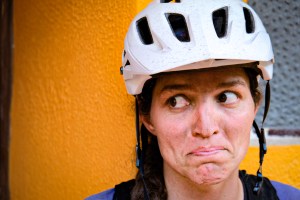
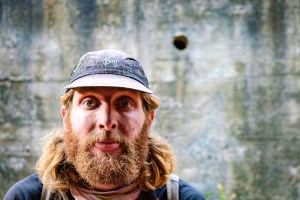
Level 59/61
Let it be said that we were naive until the very end.
Just remember that we smiled through the last high-altitude hailstorm of the trip. The day comprised 3 mountain passes, all near 5,000m of altitude, and somehow, after three days of non-stop deluge, we started the day in sunshine.
It must also be said that it takes a certain type of courage to be as naive as we were on cycling day 59 of 61. Courage since, in a way, it presupposes optimism. And where that optimism could have arisen from, puzzles me to this day. Because, what is optimism if not a courageous outlook on the future? And when has that ever done anything for us on this trip?
Sometimes, life is a little like those 2D games with the screen pushing you forward. Ever forward. If you don’t touch the controls, the left edge of the screen will drag you into whatever obstacle comes your way. If you run at all speeds and hug the right edge of the screen, you won’t be able to react in time to the obstacles coming your way.
Either way, you are vulnerable to the obstacles life will inevitably throw your way. Neither are very wise strategies and, what’s more, they’re a tad self-destructive.
I like to think that what is true of life is true of cycling trips. After all, what is a cycling trip but a miniature life within a life? Okay, yes, the sheer magnitude of this trip far outmatches that of our life, in many ways. And yes, of course, the stakes are waaaay higher, out here in the Andes. And whatever end we face is bound to be infinitely more grandiose than any which life life has in store for us. Not to mention that what-doesn’t-kill-you-makes-you-stronger is only true of life, not so in the Andes. Out here, it’s quite the opposite. What doesn’t make you, kills you stronger. What doesn’t…
Anyway. We’re on level 59 of 61. It’s late in the game. We are both mentally and physically exhausted, and moving slow, and once we start the day, the screen always zooms forward waay too fast. Our disasters are bikes waiting to happen… our bikes… anyway. We’re about to start level 59 and there’s a message flashing in the middle of our screen:
CLIP IN TO START. CLIP IN TO START. CLIP IN TO START.
Also, there’s a map of our day in the top corner of the screen. The legend reads: 124kms – 1,800m Elevation Gain – 3x 5,000m Mountain Passes.
Otherwise, all we can see are the sunny streets of Huaytire village.
CLIP IN TO START. CLIP IN TO START. CLIP IN TO START.
The rest is unknown. The rest is unknowable. The rest is optimism/pessimism. Haz tu everything is sunshine and lollipops all day, rainbows the whole bit; on paper, it would still be one of the hardest days of the trip, by a mudslide. But, with two levels left in the game? At this point, we’re clipping in regardless. Neither optimism nor pessimism will change the outcome of the day. We have about as much power over the outcome as we had over the Alpaca meat we’ve been served for breakfast. We asked a neighbour if she could cook us breakfast, breakfast was served at sunrise, looks great what is it? Alpaca. Naive until the very end.
At this point, all the omens are wrong. It would probably be wiser to pull the plu—
CLIPPED IN!
READY! SET!
WAAAAAHOOOO!
The screen zooms forward, it’s all we can do to unstick our back wheels from the back end of the screen. The first two high points of the day go off without a hitch. We’re so hyped about the sun that we actually gain a tiny advantage on the screen. So, we slow down a bit, take our time as we cycle through some of the most extraordinary landscapes of the trip. High-altitude sandy deserts and snow-capped mountains; Ceci chasing llamas and alpacas around on her bike yelling ‘Acéptanme! Soy llama tambien!! ’ A hard sale when your breath still smells of alpaca-for-breakfast, but girls will be girls. We see more wild vicuñas in one place than we’ve seen in the whole trip. A trio of vicuñas follows us around for many kilometres, displaying their unique capacity to be both surprisingly curious and incredibly skittish. Their silhouettes traced over the horizon as they ran along the crest of ridges is something I will never forget. Naiveté in such ample supply. Naiveté as the chain-lubricant that keeps our big dumb optimism bicycle shifting. Which is fantastic because, by this point, we are running out of actual chain lubricant, seeing as we’ve had to stop every hour to apply a generous amount to the stiff joints of our derailleurs. And in case you’re wondering whether it makes sense to apply chain lube to the derailleur joint, it does. About fifty-five minutes’ worth of sense. Works better, anyhow, than applying naiveté to it. That seems to produce no outcome whatsoever. Not so our optimism bicycle. That one is still running as smooth as a whistle. How can a day possibly hold so many wonders… Ooooppss!! Here comes the back of the screen, GOT 2 GOOOO!!
We are just about to cross the last high-altitude mountain pass of the day/trip when a hailstorm erupts around us. Even so. Even through the bullets of ice pummelling us with uncalled-for vehemence, we smile. Naively, we smile. And stop to apply some chain lube to our derailleurs. Not so our optimism bicycles. Those still run true as a whistle. Listen to this, even though you’ll think I’m full of… naiveté lube: the following words actually came out of my mouth.
‘How can you not believe that someone out there is looking out for us?’
See how smooth a sentence. Smooth as a whistle. How can you not believe that someone out there is looking out for us? And it’s as true as a whistle, too. One of the most espectacularly scenic days of our trip/lives and it just happens to be sunny almost the whole time? With 170 kilometres left to the trip and almost 4,000m of uphill; we not only smile. We cry, too. A rush of adrenaline coupled with the release of three months’ worth of punishing mental and physical discipline? We cry. Through the hail, through the exhaustion and hypothermia creeping in, we cry. And smile. This is it. We’re so high on altitude that we can almost see Arequipa. Through the pillow-fluff of clouds and golf-balls of hail. We’ve survived all the attempts on our lives, all the tiny underminings… All the tiny goddamn underminings. Far from us this idea that we won against the Andes; but we’ve survived and that has to count for something. So, we cry. Because it has to, hasn’t it? Count for something. Even just a tiny woohoo. No exclamation point, nothing. But, you know… something. Because it has to has to. Hasn’t it? You couldn’t make up half the things that happened to us on this trip. Even the Andes ran out of imagination, at some point. A hailstorm at 4,874m? Pshhht. Now who’s being naive?
Words will never do it justice. Even injected intravenously. Even if I punched my words into your legs for 3 months straight. Words fail me. This larger-than-life miniature life that is this cycling trip of our lives of our lives. No way. Perhaps the only thing I can think of that has a chance of conveying it, a chance of plunging deep into the swamp of it all and coming out with the beating heart of what it all meant to live exactly what we lived exactly how we lived it, where we lived it and when; would be a picture of our eyes. A picture of our eyes at the precise moment when we thought it was all over. The devastation. All of it. The devastating hope. The devastatingly hopeful naiveté.
And now. Before us? A 40-kilometre-long serpentine serpent of a road that slithers from this mountain-top to the bottom of the canyon. Three thousand glorious metres of steep downhill. We’ve officially climbed our last ladder of the trip and all we needed to do was to bike into the serpent’s mouth, glide down to the very tip of its tail and then we would so almost be done our trip that we could realistically almost think about celebrating. Which made this serpent’s head of a 5,000m tall mountain, the last hypoxic hypothermia of the trip. The last hypothermia of the trip! Impossible to convey what we felt at that moment. To be parts freezing parts numb and wholly soaked through… but! With home in sight. The cold felt good. It makes no sense, but you get it right? It felt good. The cold. It felt goooood. Wrap your mind around it. For me. For us. Hypothermia is who we are at this point in the game and it feels good because it means we are still alive enough to feel good about feeling bad. Do you understand how twisted that is?
The first time. In the whole trip! The first time I could actually think ‘I see your cataclysmic weather and raise you a devil-may-care nonchalance!’ In other words, once we lift our bikes over the serpent’s teeth and start gliding down its 40km-long tongue:
What.
In.
The.
World.
Could.
Possibly.
Go.
Wrong?
We held hands, even though our fingers were too numb to know it. And with a Yip! and a Yuuu! we initiated our descent.
The weather shifts by the second when you lose altitude this fast and with every curve in the road, we inched closer to succeeding in the last thing left for us to succeed in: reaching a point when we can never ever ever touch a bicycle again for the rest of our lives, Amen. Halfway through our descent, a man offers us some yellow and red and green and pink Tunas (Cactus Fruit). Having packed the whole harvest into wooden crates stuffed with grass and bound for Arequipa, he feeds us the leftover Tunas from a seemingly bottomless bucket. With a small hand-scythe, he proceeds to skin them faster than we can chew. Our mouth is so stuffed that we can’t call for help. By the 10th, we’re drowning. And that’s when Ceci’s father’s wise words about Tunas creep into our minds.
‘Las Tunas son de mis frutos favoritos, pero come mas que 3 y te tapas!’
Words to live by. The cactus fruit, sweet and juicy though it may be, is made almost exclusively of tiny seeds. And even though I’ve lost count by now, we’ve already certainly quadrupled Ceci’s dad’s recommendation of a maximum intake of 3 to avoid full intestinal stoppage… and counting. By the 15th, I raise my hand. Enough. Basta. Ya!
After many thanks, we carry on. Could we have known that this was the only meal of substance we would eat in the whole day? Okay… you caught me… Although, were you to receive a breakfast, a real warm meal, on a plate, for the first time in more than a week, and accidentally said ‘Que rico!’ before asking ‘Que es?’ and receiving the answer ‘Alpaca!’ at 5:30 in the morning; I think you’d side with me in thinking it a meal best forgotten.
We descend further into the valley as vast storm clouds hide the sun. The sun. That same sun brightening the screen when we CLIPPED IN back in Huaytire. Here’s the thing and there’s no escaping it: The days are always 100% inevitably longer than our optimism. There are often 2-3 days’ worth of adventures packed in every single day. And that’s not to even speak of the misadventures. Naiveté is just not that sustainable a lube.
We bottom out at 1,700 metres over sea level and cross to the other side of the canyon on a narrow bridge over a raging river. We’ve gained so much time on the back end of the screen with our descent, that we don’t even notice that our nose is pressed against the front end. Who cares, though. Right? There are about 30 kilometres left to the day and in two days, we’ll be back in Arequipa, sipping tall glasses of Lucuma con Leche, getting up late and eating at our favourite restaurants… It’s so close, we can already taste it. Oh. How. Naiveté.
The road turns to mush under our wheels as we excrete ourselves out of the serpent’s tail. Suspiciously mushy. Buckets of rain begin to fall. Whipping us across the face. Suspiciously wet. We slip and slide and we have nothing left in the tank but 13 kilos of Tuna seeds. Dead-weight, by now. But it’s warm-ish at this altitude and we’re almost home, so, ‘I see your cataclysmic weather and I… and I… Oh.’
Out of the serpent’s tail into the serpent’s mouth. Mudslides. Whole moutainsides’ worth of them. Almost molten-lava in speed — quicksand in consistency. It’s not wet. It moves like it’s wet, but it’s just sand and stones and we’re half a bike deep in the stuff, before we know it. And it’s pushing us backwards. When we try to move it sucks at our feet. It sucks at our bikes. Sucks whatever reserves of willpower left to us. Never mind energy.
We look up. This is just a side-spill of the mudslide. Ahead of us, moving at three times the speed, a veritable river of sand and stones flowing down a 2,000m-long gully. The mountains all around us… Our nose was so smooshed against the front end of the screen that we never even looked up. We’re in a 2-3,000m deep canyon, sandwiched between its steep walls and the raging river, 500m below. And the mountains… the mountains are made of sand.
Suddenly, the screen stops scrolling forward. The lighting turns gloomy. The music changes. The tempo is frantic. The tone, grim. You know the one. We’ve reached the big boss end of stage 59. Now the only question is what’s our Bowser? And how many are there? You know the drill: we’re out of lives, we lost all the superpowers we’d accumulated along the way… Simply put: Naiveté could only get us this far. Now we’re on our own.
And all I can think is how estupido stupid we are. Remember the Peruvian skies going blue in the face, waiting for our arrival to unleash biblical floods? The final cataclysm to befall our trip was never the rain. Here we were, cycling through it for days, screaming at the skies ‘Is that all you’ve got?’ Well, it wasn’t. Not by a mudslide.
We’re 13kms away from our final destination. Backtracking would mean 30kms and 1,900m of uphill. Not to mention that if there are mudslides here… Not to mention that you DO NOT backtrack in the Andes. Remember?
We plow onwards to the main flow of the mudslide, my mind reeling with news footage of mudslides. You know, how they make the ground extremely unstable? How from one moment to the next the ground collapses underfoot and whole entire houses get swept away and buried? We stop to contemplate the dimensions of our doom while stones careen down onto the road from unfathomable heights.
Life or death. We have no time to lose. Ceci stays with the bikes as I walk up and down the flow, looking for a place to cross. My best guess is not a good one. My leg sinks up to my knee and, instantly, I learn a life lesson. Life or death? Your knees are the difference. If the quicksand reaches over them, there is nothing left with which to pull yourself out. Not to mention up to your hips. I lean back on the strip of stable ground behind me and, pushing furiously with my other leg, I manage to free myself from the sucking quicksand. The effort leaves me drained. Luckily, my next best guess to get us across proves… somewhat better. I go back to tell Ceci.
Who is taking a video and laughing nervously. And for a second there, I lose my cool. I don’t care how that sounds. Life-changing experiences are Ceci’s department. Making sure we stay alive? I’m here, this is me, go. Don’t care how that sounds either. I’ve been afraid of losing Ceci to Ceci Danger ever since we’ve been together. So, put me in coach, I’m ready.
First step: Life or Death. This is as real a risk as it gets. It is paramount that we both share in this understanding. Time is not on our side and there is no such thing as waking up at the start of the trip with all our hearts replenished, if we fail. So, I make sure we’re on the same collapsing-ground-sweeping-entire-houses-away page. And it takes a second to sink in, but we get there. Ceci is no longer laughing, I am no longer angry. And when we move, we move as one.
Life or death. Everything is at stake and we can’t stay here, can’t turn back. We have to wing it. Our progress is slow and the way I picked turns out to be good for about halfway through the flow. We have to improvise the second half. And in the process, we are taught a sobering lesson in just how quickly things can get out of hand. The sheer force of the flow — how stuck we get, how we have to lift the bikes, the way the bikes drag and can topple us over — the vertical drop-off about 5 metres away and the raging river below. We push on. Our bikes, our gears, our chains, derailleurs, pedals… everything is coated in several kilos’ worth of wet cement. We grind our way forward through the rain and mud.
Not a kilometre down the road, we cross a smaller mudslide. It gives us hope. Not another kilometre down the road, we lose that hope. We shed it like dead skin. There’s a truck stopped on the road in front of another even more massive mudslide. If that’s even possible. And it is. The truck is stuck with two impassable mudslides behind and one mudslide ahead, slowly creeping towards its wheels. Threatening to drag it down the road and, eventually, off it. There is nowhere for it to go. Nowhere for us to go. About ankle-deep in mudslide, we fight our way to the woman and man inspecting the dimensions of their doom. Upon reaching it, we chat with the couple, take stock of the situation and debate the best course of action. Their truck would at least provide some shelter from falling rocks. When it becomes clear that the only way forward for us and for them is for us to carry on and warn people in the next village over, we push on. This mudslide having no clear path off the cliff, covers a huge swath of the road in shin-deep quicksand. What makes it less dangerous makes it inhumanly draining to navigate. And as we do, we hear an enormous collapse in the distance ahead sending a huge plume of sand bursting into the air. Let it not be the road. Please. The water-logged skin of our feet is rapidly getting exfoliated raw by the grit in our socks and we have yet to hop on our saddles again before we reach the next bend in the road. The rain relents a bit and the next two mudslides prove more watery. The flow is faster by far but instead of trying not to get stuck, all we need to concentrate on is keeping our momentum, and timing our crossing so as to avoid the large stones tumbling half-concealed in the current.
The 6th mudslide is like nothing we’ve seen. Even from a distance, it looks uncrossable. Fifteen metres wide, fast-flowing, waist-high, the sand and stones of a darker shade of grey… there is no way we can cross this thing. The road can’t be more than 4 metres wide, if there still is a road underneath the flowing dirt.
Life or death. There is no way you can know. This compares to nothing we’ve ever lived. A boulder can come down and crush us. The road can collapse. The mudslide can carry us off the cliff. We can’t camp here. We can’t go back. Less than 10 kilometres left to the day. One hundred and sixty-five kilometres left to the whole trip.
‘Voy.’
‘Okay.’
There is nothing more to say.
It takes everything I have. My bike weighs over 40kg by now. And to this day, I’m certain that the only thing that got me through was yelling. At the top of my lungs. And with every two feet I manage to drag forward, the slide pushes me one foot closer to the cliff. We are both at the absolute fulcrum of our fitness and at the absolute rock bottom of our energy. Utter and crushing mental and physical bankruptcy. I’m about 2 metres away from the side of the cliff and almost through the deepest part of the slide when I hear it. I turn back and the world slows down. A nightmare. My nightmare. Time slows but its onslaught is inevitable. I can see everything happen, I can see everything that will happen, I can see everything that has happened to spawn this nightmare… But there is nothing I can do.
Ceci’s bike is getting dragged away from her, towards the cliff. And for holding onto it, for trying with all her might to bring it back, it drags her down with her. First to her knees. Then to her hips. It is not about willpower anymore. Not a question of physical strength. Not a question of energy. Buried up to the waist, one arm trapped underneath her, nothing solid to hold onto, nothing to hold on with. It is only a question of time. Slow, inevitable. Time.
Life or death.
‘No, no-no-no!’ I scream. And it’s instantly worse. The nightmare is instantly more real for hearing myself screaming it.
This is not how it ends.
Life or death. This is me. Go.
I throw my bike as far as I can away from the flow. Forty kilos… it doesn’t reach far. When I turn back, Ceci is no longer where my eyes left her. The drag is way faster when you have nothing to hold onto. Should I have turned? Would this be the detail that would haunt me? No time. Free from my bike, I start fighting towards her. And I mean fighting. There is a molten seismic detonation of wrath inside me and it barely makes a dent against the despair. One sucking foot at a time. I’m only a head taller than Ceci, but it saves me. My knees hover barely an inch above the flowing cement but it proves enough. Ceci’s not a half-metre away from the cliff’s edge when I reach her. Half-buried already, I barely manage to lift her bike out. Large stones are hitting my ankles as I try to stand still in the flow. What happens next is a blur. I’m not sure if Ceci uses the upright bike to pull herself out, I’m not sure how perilously close we were to going over the edge, can’t remember how we ended up on the other side. Pale as ghosts and with barely the energy to stay on our feet. We just get there. And start moving again. Near-death is no ward against all the possible dangers awaiting us still. Night’s coming, the whole ground is shaking with the strength of the mudslide, huge rocks are falling… we’re not out of trouble yet.
One more mudslide blocks our path and it starts raining again. We re-assess and decide to cross it together, holding one bike at a time. The technique works, and even though we have to cross the mudslide twice, we manage to do so a lot more efficiently. Seven mudslides all in all.
Nine kilometres down the road we find a small settlement and warn a police officer about the mudslides and the people stuck in the middle of them. The officer says he will take it over from here, but still, it’s hard for us to just let it go. Night is almost upon us and we could just as easily be the ones still stuck there. Most of who we are is still stuck there. What’s left is husk.
Eventually, with little more we can do, we keep cycling. Our destination, as it turns out, is 10 kilometres farther down the road than we’d thought. Welcome to Peru. Add it to the pile.
When we finally reach it, we have to bypass the main vehicular bridge because it got compromised by the overflowing river. We head back upriver and cross on a narrow pedestrian bridge, the river raging less than a metre beneath our feet.
We’ve made it to that little bit at the end when your character moves without using the controls with some celebratory music in the background you can’t really hear because you can’t really believe you survived. As we near the centre of the small town, we find a crowd of people separated by a fast-flowing river of muddy water.
‘No, no, no!’ they say when we get closer.
We stop. Hop off our bikes. Having literally just stared death in the eyes, I try my luck. The river isn’t even shin-deep. And when I cross it successfully, everyone laughs and applauds. How to explain. Do you understand? How to explain. I can’t. Not to you, not to them. I could say we crossed rivers 3x deeper than this before breakfast every single day of the trip. Our tallies have to amount to an average of 4 river crossings per day. I could mention whatever just happened back there, not 20 kilometres up the road. What did happen? Did it really happen? Did we just almost die 45 minutes ago? It’s somehow hard to believe now.
And yet, not as hard to believe as the fact that we were allowed into a guesthouse for the night. Despite carrying half the mountain range on our clothes, in our pockets, in our shoes and socks, on our bikes, in our souls. To our surprise the woman took it all in stride, asked us to pay in advance, gave us a mop and disappeared, leaving us to our hour of in-depth showering. There was about a foot of grit at the bottom of the shower when we set out to find something to push the intestinal blockage of Tuna seeds along.
‘No hay.’
The only restaurant in town. Ran out of food. The cook recommended that we go to the only shop in town, down the street, and ask them if they would boil some eggs for us.
‘No.’
No need to translate that, I suppose. Not ‘we don’t have’. Just no. Now, if you think there is something profoundly anti-climactic about eating plantain chips and roasted haba beans for dinner after all that; if plantain chips and roasted haba beans are not, as they say, your cup of tea; then, let me just say this:
A bit of salty, a bit of sweet, a bit bitter, a bit spicy… what more can one ask of life?


The Infinite Pastries Paradox
Write Pasto, Colombia in the palm of your left hand. Arequipa, Peru in the palm of your right. Stretch them apart, as far as they will go. That’s our trip. Welcome. Our whole entire trip, between your hands. A detailed, to-scale, 4,300km-long cross-section of the Colombian, Ecuadoran, Peruvian and Bolivian Andes. Down to sea level and up to 5,100m, with a whole bunch of squiggles in between. If you look closely, you can see every single storm lurking above the exact spot where it unleashed itself upon us.
Now clap! Squash all those mountains together so that what you are left holding is one, single, unidimensional mountain. That mountain is 90,000 metres high. More than all the other elements combined, this is what we were up against when we started the trip. Ninety thousand vertical metres. Now, plant it firmly into the ground and take a step back. This one, single Andean mountain stretches up into the thermosphere. One whole layer of the atmosphere higher than our Indonesian trip, despite it being roughly equal in horizontal distance. If Indonesia was as high as comets, our Andean trip reached Aurora Borealis.
Would you leave for this trip?
Forget all the other elements. The rain, the dirt roads, the altitude, the 35-40kg loaded bikes…. Just this: 90 vertical kilometres.
Would we leave for this trip?
Ceci would say yes. I’m certain. As certain as I am that I would say no. Categorically.
Ceci is a child of chaos. There are no parameters to her. Infinity fits inside her, no problem. Two infinities? Why not. Never mind that ninety-thousand metres of climbing is barely something a mind can grasp. If you told us before the trip that we would climb 54,000m, as much as in Indonesia, we probably would both have said, ‘What? On muddy dirt roads, at altitude, in the rain, etc. No way!’
My no-way, of course, would mean no way. As in no. Ceci’s no-way is more like: A bike made of chocolate? Noo waay!
Ceci is a child of chaos. A boundless trip for a boundless person. Whether it is doable is beside the point. Triple the uphill and she would say yes. Promise her Aurora Borealis at the end and watch her climb. That is because to her it’s not a matter of uphill but rather a matter of pastries. AKA, a little something I like to call: The Infinite Pastry Paradox.
Ceci has this conception of herself that she is a black hole for pastries. That if she begins, there will be no end. So, she doesn’t. Begin. And so she remains boundless.
Not I. I am a child of order. Every so often, I’ll eat pastries until I puke. I’ll eat pastries so much that I’ll swear off pastries forever more. Thereby reminding myself that there is such a thing as too much of a good thing. There are bounds to pastries. There are bounds to me. For me, 90,000m is a finite number. You can’t wrap your mind around it. But it’s not infinite.
Let me break it down for you. My favourite pastry is a croissant. A standard croissant is about 5 to 6.5cm in height. So, let’s say 5.75cm. If we allow for a 90,000m hole to be roughly standard croissant in diameter, it would only take about 1,565,217.39 croissants to fill it. Now let’s say that hole is Ceci’s stomach. A professional female athlete requires roughly 3,500 to 5,000 calories a day. Let’s settle on 4,250. If a standard croissant contains about 200 calories, Ceci could theoretically eat about 21.25 croissants a day, no harm no foul. Calorie-wise, anyway. It would, then, only take 73,657.2889 days to fill that hole. Which is about 201.8 years. And while, of course, it might be hard to wrap your mind around it; it’s not infinite.
I’m a good athlete, but riding 90,000m of uphill, in 61 days, is outside my limits. Which means that to accomplish it, I need to exceed my limits. So then, it becomes a question of how much excess per day. How much more than what I have to give will it take to fill such a hole? How deep would the hole have to be, inside me, for it to fit a 90,000m high croissant-shaped Andean mountain? Too deep. Way too deep. So, I say no.
Ceci is a child of chaos. She says yes. She is a black hole for vertical metres. Of course, 90,000m fits. That’s all? Yummy!
I am a child of order. And since Ceci just keeps saying yes, let me break it down into further subcategories.
How many more croissants a day beyond my safe caloric intake threshold would it take to fulfil this mission in my lifetime? Let alone in the 3 months we’ve allotted for this trip? Well, since you ask, of course, puking is an arbitrary notion. If I absolutely have to, I could conceivably keep eating croissants after puking. How many more? Until I die, I suppose. That’s the only real limit.
‘I can’t anymore’ is based on the conception of suffering as a choice. Unless it’s a matter of life or death, what we really mean is ‘I won’t.’ The trouble is, we get so used to conflating our willingness to suffer with our actual limit that, in extreme circumstances, it may conceivably prove to be so. Convince yourself that you’re too dead-on-your-feet to keep pushing through a high-altitude storm, and hypothermia might very well bring you to being actually dead on your feet.
See, for me, child of order that I am, it’s a matter of houses.
There exists the world at large: chaos. But I mostly operate inside the confines of my house: order. I leave the safety of my house daily to explore and gather information about the world at large. And whatever knowledge or experience I forage helps grow my house. Helps me confront the chaotic world outside with more wisdom. Helps me generate frameworks of behaviour that I can test on future expeditions into chaos. But, in general, I act within the confines of my house, knowing that, when I do, my actions are based on authentic and sound foundations.
Whether in Laos-Thailand-Malaysia, in Cuba or in Indonesia; this framework helped me visualise our trips. To order them into assimilable chunks.
Which is why I ultimately said yes. My house has grown quite a bit in size, over the years, regarding cycling trips. So, based on a framework that immediately proved entirely inadequate for this trip; I said yes. And from the very moment we set wheel in the Andes, it became savagely clear: we would be eating 1,565,217.39 vertical croissants whether we wanted to or not. Our willingness, or lack thereof, to eat over 1½ million croissants was summarily disregarded. Our opinion on the matter? Of absolutely no consequence. Much much less our doubts and complaints.
That’s 19,323.6715 croissants of vertical uphill per day, in case you were wondering.
The truth on the ground was this: when you face a 90,000m mountain, how much you are willing to give has nothing to do with it. It simply does not factor. From the moment we started cycling, we resided entirely in the realm of how much we were capable of giving. Which, it must be said, still presupposes some modicum of choice. (I.e. the choice to survive or not.)
The game changes, however, when you start to factor in the elements. Under rain, in snow. At altitude. Over 4,300kms. On dirt roads. At times in full darkness. On underdog, overloaded bikes. Through rivers, mudslides, lightning storms, hail storms… All the elements combine to make you wonder: Perhaps death by croissant overdose is possible.
Physically, of course, there probably is a point when the body kicks in and prevents you from eating more; I don’t know. But in the Andes, quite the opposite is true. You have to force yourself to move, to eat and hydrate, to push through hypothermia, darkness, uncertainty, confusion, exhaustion, muscle pain… You have to force yourself to ride towards the storm. Through the storm. Even as all your instincts tell you to stop. This is when it becomes a question of: How much can be taken?
The Andes take all the agency out of the equation. Looking back, not even our choice to cross the Andes by bike seems wholly ours. One day, we got the famous call of the mountain and we answered. We said yes. Ceci thinking: Well, if Etienne can do it. Me thinking: Well, if Ceci can do it. And the rest is French baking history, as they say.
From the very moment we started cycling, however, the Andes ceased to be one monstrous 90,000-metre-high mountain. It only seems like one 90,000-metre-high, 4,300km-long croissant when you use foresight as a tool.
Here’s what I mean. Take even just one day, arguably one of our hardest: 81km with 3,005m of elevation gain, at high altitudes, through freezing rain the whole day, finishing after dark. Before the trip, all these elements were foreign to me. But still, there were ways for me to compute them. I’ve never done 81 kilometres on destroyed dirt roads before. But, I once cycled 300km in a day, so I can probably pull it off. I’ve never ridden 3,005m of elevation gain in a day, but once, I ran 4,400m of elevation in a day, so I can probably… I’ve never even been at such high altitudes, let alone while riding a 30-40kg mountain bike, but…
Once you start pulling on that thread, it will either tighten the weave into something impenetrable or unwind it into something insubstantial. However much I sit in my house and crunch the numbers, there is no framework I can conjure to make this trip digestible. And that is because there comes a time when computational power peaks and beyond that, nothing more can be achieved by it that cannot be achieved more efficiently by simply letting go. No manner of logic and rationality will ever win against the simple and courageous act of stepping out of doors.
Ceci on the other hand is a fish. She does not need a shore. And as such, she is always adapting. Faith in our adaptability restores dimension to the map by allowing each trial to come at its own time. It’s not a matter of knowing whether or not you can overcome a 90,000m-high mountain of croissants. Just a matter of knowing that you can overcome. Period. That you are an overcomer. And that’s enough to get you started. The rest is eating croissants one pedal stroke at a time.
The odds were against us from the start. Against our meeting. Against our working together as a couple. Against our pulling off a trip such as this one. It’s become our tradition over time. To gamble against the odds, in order to remind ourselves of who we are. It took a lot of squiggles to reach where we are now. And in terms of squiggles, this trip is our magnus opus. We were on our own out there. Unprepared. Underprepared. And the Andes reached in and got the best out of us. The absolute best.
The croissants of who we are, are not infinite. And once in a while, Ceci needs the reminder. However, nor are the croissants of our potential as finite as I sometimes believe them to be. And I, too, need a reminder of this from time to time.
This was a Ceci trip, through and through. So why did I say yes?
I am a child of order. For me, it’s a matter of houses. Outside the ordered confines of my house, there exists the world at large. Chaos. Where a child plays. I can glimpse her outside my window, from time to time. Purple-lipped and still, smiling. Drawing squiggles and shaping mountains in the mud. She knocks on my door sometimes. Always in the worst weather. She says, ‘Puede salir Etienne a jugar?’
Why did I say yes?
Who could say no?

Pilgrims
A pilgrimage, whether on foot or by bicycle, is a spiritual journey. As such, it is quite intricate to delve into its symbols without borrowing the lexicon and imagery of both religion and superstition. However, by weaving the wayward threads of our journey into a truth all its own, I believe we eventually succeeded in transcending the training wheels of Christ and Pachamama, to find our very own two-wheeled equilibrium.
It is a precarious moment when a child rides on two wheels for the first time. A delicate balance struck between the weaving side to side of too little momentum and the exponential risks of building too much momentum. Travelling the Andes, we certainly experienced both. And the same is true of writing these articles. I like to visualise the almost stream-of-consciousness teetering between themes in each article as this unique moment in a child’s life. The unique truth of our Andes trip only gradually revealed itself to us. Throughout the Ecuador chapters, you can almost hear the grinding of the plastic training wheels. And if you trust in the natural evolution of such moments of vulnerability, the reader may find him/herself reading like a parent smiling in the margins, eyes watering at the beauty of a catastrophe about to take shape, barely held at bay by the whims of fate.
The tiny villages and vast landscapes are, after all, profoundly spiritual places. And the immense significance of each helped us digest the brutal nature of our endeavour. To start the new year in Peru marked the breaking-in of a new marathonical chapter. The nature of our pilgrimage shifted from under us. Overtook us at a gallop. The soulless savagery of the elements unleashed. Here mines, minors and mining towns. Here too, vertiginous heights. Breath-taking heights. Here thunderstorms, here hail, here extreme remoteness. The mythos of such places, no longer sufficient to subjugate the brutality of our undertaking. And if like smiling teary-eyed parents the reader watched on until now, now he/she would inevitably and uncontrollably find him/herself yelling ‘Use your brakes! Use your brakes!’
Here, we began to swerve and lose control. Religion or superstition broke off and we were left rudderless. The true colours of our pilgrimage began to swirl before our eyes, red and white and red, hypnotising us, entrancing us onwards. And whereas, theoretically, one might read into it the red and white and red of Peru’s national flag; the truth on the ground took the shape of the interlaced red and white and red of a Chinese finger trap. That is to say, the outside observer might see us suffering and yell ‘Use your brakes! Use your brakes!’; acting on the truth that ‘Ceci and Etienne are cycling in Peru.’ Which is to say, based on the presupposition that Ceci and Etienne can as easily stop cycling in Peru. Which is to say back out of our pilgrimage.
Our intuition at that moment was based on a different truth. Peru, by then, had wrapped and interlaced itself around us in such a way that to back out would only mean the tightening of its grip upon us. The only way out of the Chinese finger trap of Peru was in. And if we could not entirely put our finger on this truth at the moment, it was nonetheless the truth we obeyed. There is a hidden logic to such intense journeys which is never entirely graspable. When you think you can just catch a glimpse of it, it shifts. Hides behind the next mountain and the next.
Perhaps this explains why I always find it difficult to attack the truth in these articles head-on and take such circuitous routes. It takes stealth and wile to entrap symbols. And yet, if one does so successfully, they hold a mysterious magic to be truer than truth. Just like Pachamama holds more symbolic truth than any topological map of the Andes. When our bikes broke down on the Peru Divide, we were faced with the reality of our situation. And, throughout our debates concerning the future of our trip, the underlying Chinese-finger-trap truth of our pilgrimage proved the actionable truth.
So, rather than backing out, we pushed on with the hope that, by flowing with the trip, by seeing it through to the end, we might find the release we needed to extricate ourselves from its grasp. And by doing so we reasserted ourselves as voluntary pilgrims. No longer to be sucked in and dragged along, but to journey the path ahead with as much dignity and grace as we could summon. We were finding our own way. And as our perspective on our pilgrimage broadened, a new lore, a new mythos, a new faith and new beliefs were beginning to take shape. Whose pantheon held tremendous sway over our lives, regardless of the fact that its players were as odd and eclectic as a plastic bag with ‘Grin’ (for gringo) written on it and its mysterious charm to make one laugh and/or weep uncontrollably. Or a tent whose waterproofness catastrophically disproved itself in the worst possible moment. Or severely underdog bikes which were nonetheless amenable to cajoling and coercion towards the working of little miracles. Or Richy Carapaz Cannondaling past us in his shiny pink EF armour but not without first paying his respects. Or brave Sarita of the five daughters, patron saint of lost cyclists. Or Trululu gummies and their formidable might of tasting mighty formidable when there’s nothing else to eat…
Our daily survival wholly depended on the rubbing together of these little voodoos. How else to interpret the unique nature of our journey than by giving each of these elements their rightful due? Than by worshipping the exact hands that pulled at our strings with prayers whispered under our breath in times of need? Utterly at the mercy of the elements, how else to tilt what little juju we might influence than by daily pilgrimages to steaming cauldrons of chicken feet soup? How else but by faith in lost satchels of ramen powder? Or the ritual of pressing coca leaves between gum and cheek?
The challenges we daily faced often superseded the mere fact of pushing on pedals and tugging on handlebars and breathing hard. And so, accordingly, our rituals became more intricate than the mere hydration, nutrition, rest, repeat; of cycling. To win against the day we often relied on the sacrificial drinking of obscene litreages of soda. Or the ceremonial filling of one’s cycling shoes with volcanic sands. Or the interlacing of fingers around pastries. Or the prostration before llamas and Puya Raimundis. The daily ablutions by rainwater and hail and snow.
All this to favourably incline the spirits towards the myriad life-changing decisions we hourly took. It is an intricate alchemy, to be sure. But little by little we made it ours. Intuiting our way by stumbling around in the dark. And, somehow, it kept us afoot. Afloat. Astride our bicycles.
No less than our lives were at stake. But when are they not? So it is of no surprise that it took our closest brush with death to finally extricate ourselves from the Chinese finger trap. It took reaching within an arm’s breadth of the ultimate release to free ourselves. And I must say, we acquitted ourselves with courage. If not exactly grace. Or dignity.
Once the trip was over, it took a while for us to understand who we’d become. What such a journey made of us. Moulded us into. That like the Wiley Coyote, we’d cycled over the edge of the cliff a long time ago. And yet managed to cycle on mid-air, unsuspecting of the canyon below. The RoadRunner of our better selves so blinded us, that the chase became all-consuming. Allowing for events that defy understanding to take place.
Suspended in mid-air, our momentum slowly waned and still, we kept cycling idiotically forth. And for a moment, we were able to look back at the path we’d travelled. Celebrate it, even. Until, looking down, reality kicked in. With a hard gulping swallow and holding up a sign that reads ‘HELP!’ we finally re-inhabited our bodies and fell into the deep dark canyon of withdrawal which invariably follows such trips.
And there in the deep down canyon of hurt, the world gradually began righting itself and the wrongness of what we’d allowed ourselves to become could no longer be ignored. And, somewhere in there, also the significance of what we did. The whole Andean trip was one big Russian doll of Chinese finger traps. Where even the innermost doll had inward pointing teeth. Open, stick finger in. Shoot… Hey, look, what’s this? Open, stick finger in. Shoot… Hey, look! It required so much commitment that, in the end, as time edits out the suffering, the initial panic, the frantic yanking, the head-scratching, all that is left is the commitment. To the journey. To one another. Once it all fades, all that will remain is having given everything we had. To the journey. To one another.
The Chinese finger trap of our lives has come to take odd shapes over the years. And now that we have narrowed in on it, it seems there is no sphere of our life where it is not at work. You can find it in everything we do. Sometimes I wonder whether even our lack of wedding rings speaks to this truth. Perhaps we intuited, even then, that there was a stronger bond between us. Our whole relationship is based on diving blindly into the deep end. On doubling down when surrendering would have been best. On pushing on even when all signs pointed to disaster. And yet, for all the misadventures it has wrought over the years, I can’t help but see it, overall, as a mechanism for good.
The Chinese trap of our relationship has held us together when we might otherwise have been pulled apart by overwhelming circumstances. For long enough that, even were we to relax enough to free ourselves, we would still want to be stuck together.
Every time we returned from a trip we would always wobble and waver. Having lost an overpowering goal to unite us, we would wonder who we were to one another. Oddly, now that we recognise the pattern, now that we grasp more fully how to disarm the trap, the need to do so has vanished. We’ve turned an unconscious pattern into a tool to achieve incredible things.
Perhaps it is also true that the only way our relationship could have reached this point was by surrendering the way back, the way out, from the very beginning. We will never know, because from the very start, the stakes were sky-high. And all we’ve done ever since, was to see the other’s bet and up the ante. Stay tuned for our upcoming Cycling Saturno Magazine!
South Peru & Bolivia
Total Distance: 1,742km
Total Elevation Gain: 30,674m
Total Cycling days: 23
Total days: 27
Total Cycling Hours: 90hrs
Longest Day total: 11hrs 27min
Most Cycling Hours/Day: 8hrs 55min
Most Distance/Day: 125km
Most Uphill/Day: 2,988m
Highest Altitude: 4,968m
Trip Totals
Total Distance: 4,237km
Total Elevation Gain: 89,898m
Total Cycling days: 61
Total days: 72
Total Cycling Hours: 300hrs
Longest Day total: 11hrs 5 min
 LifeAthlon