‘Nos disparó,’ I say.
‘Quién?’ Ceci says.
‘El güey ahí, gritando.’
‘Cómo crees?’
‘Si mira…’
Together we look over to the tiny man screaming at us in the distance, waving his gun, a plume of smoke rising over his head.
‘No manches.’ Ceci says. ‘Pues vamonos, no?’
‘Un segundito,’ I say. My phone died a few moments ago and I’m not quite done connecting it to our spare battery. It’ll need a little while to reboot, but it can do so while we carry on pushing our bikes up a steep slope through the loose sand and stones.
We are technically trespassing. We did technically bypass a gate back there on the hill, where the man is still yelling at us waving his gun. Is that sufficient motive to get shot at? Debatable. Although to be fair, we never heard the bullet zip by. So… probably a warning shot? Who knows. We were only just following our map. It’s the mine that switched things out from under us. Building a new dirt road and fencing-off the old one. And in our defence, without a map, where the hell are we? If the map says to turn right, it’s not a proposition. We’re swimming in the high seas out here, we can’t just wing it, we can’t just tell our only safety boat: ‘Hey, we’ve got it from here, so long and thanks for all the fishes!’ What it is, is like a… like a train track, I suppose. From the moment we stray, the little sense we already make, navigating the Andes on our bikes, just psshhhts, evaporates.
So when the mine guard shot at us or the sky or whatever, it’s not like we could have said:
‘You know what? Darn it but he’s right. Maybe we shouldn’t be going through the mine’s property, even though when this ride was mapped, the mine’s property did not extend this far.’
‘Maybe when we arrived at the gate we should have stopped and gone looking for a man with a gun and a propensity to aim it at people or the sky or whatever.’
‘Maybe we should go back the way we came, through uncyclable stone fields, back up the nearly 2,000 metres of downhill we just negotiated through the roughest most bike-breaking terrain of the trip, back to the altitude of 4,200m, across the absolute middle of nowhere for 6 hours, near sundown, with only 20 kilometres left to our day.’
The thing is, the odds are against this little man to be the one to take us out. We’re in Peru now, and Peru-Ceci&Etienne is nothing like Ecuador-Ceci&Etienne. Peru is way more wild, way more rough around the edges. So, we adapted. If in Ecuador we often reached that sweet sweet limbo between adrenaline and exhaustion, Peru’s version is quickly revealing itself to be something like an unpredictable punch-drunk flip-of-the-switch between ‘Please god, no more!’ and ‘Is that all you’ve got?’ Between ‘Madre Santissima!’ and ‘Chinga su madre!’ What..? All my Spanish comes from Ceci. Go talk to her.
My point is this: get in line. Whether the guard’s aim is likely to be good or not is the leastest of the conundrums we’ve already faced on this day. And there’s a long way to go still, through the driving rain, across raging rivers threatening to sweep us away, bike and all; through packs and packs of snarling, biting dogs; all the way to the inhospitable ghost town of Mollebamba.
And besides, shooting at someone or the sky or whatever, kind of works at cross purposes, wouldn’t you say? Especially if what you’re trying to communicate is, ‘Come back. You can’t go that way!’
Perhaps, it’s just Peru-me.
Not that there is ever the slightest most remotest chance that we would ever backtrack. Because there isn’t. Even if what the man shot at us was a gift-basket full of lucumas and baby alpacas and t-shirts that say ‘Alpaca Baby!’ in a cool cool curved text format around the drawing of a baby alpaca wearing aviator sunglasses with a long piece of dry grass sticking out the corner of its mouth. No way Juan José… García… Pérez… De La Santíssima Cruz. Amen.
In the Andes, the concept of backtracking is about as appealing as… well, as it sounds. About as appealing as hoping for someone to shoot gift-baskets at you full of lucumas and baby alpacas and t-shirts that say ‘Alpaca Baby!’ in a cool cool curved text format around the drawing of a baby alpaca wearing aviator sunglasses with a long piece of dry grass sticking out the corner of its mouth; but instead, you get shot at with a gun gun with bullet bullets inside it. Even if only allegedly. Yes, allegedly, because the jury’s still out on whether or not the bullet that might, just as allegedly’ve been shot at the sky or whatever™, might just decide to fall on us regardless.
And besides besides, we’re pushing our bikes through loose sand and stones, uphill, so it’s not like caring about being shot at would manifest in any significant increase in pushing-our-bikes-uphill-through-loose-sand-and-stones speed. We’re doing the best we can already. Bester isn’t a word for a reason. No wait, you probably read that backwards. There’s a reason bester is not a word. There.
So, there. I think that about puts you in our malodorous and sediment-rich cycling shoes.
Now, picture green green rolling hills of swaying sound-of-music grass, with massive monoliths of stone reaching up into the blue blue sky to drag at the soft cottony underbelly of shifting clouds; and tall white waterfalls feeding blue-green lagoons with a winding road of golden dirt flowing river-like through it all. This was today, too. Somehow. Only a few hours ago, in fact. Somehow the fabric of hours can withstand containing such extreme extremes, all at once. In fact, this cataclysmic contrast of wonders and disasters, so constant as to have become routine, forced us to elaborate some sort of code of ethics, if only to ensure that the Yin never leached the light out of the Yang.
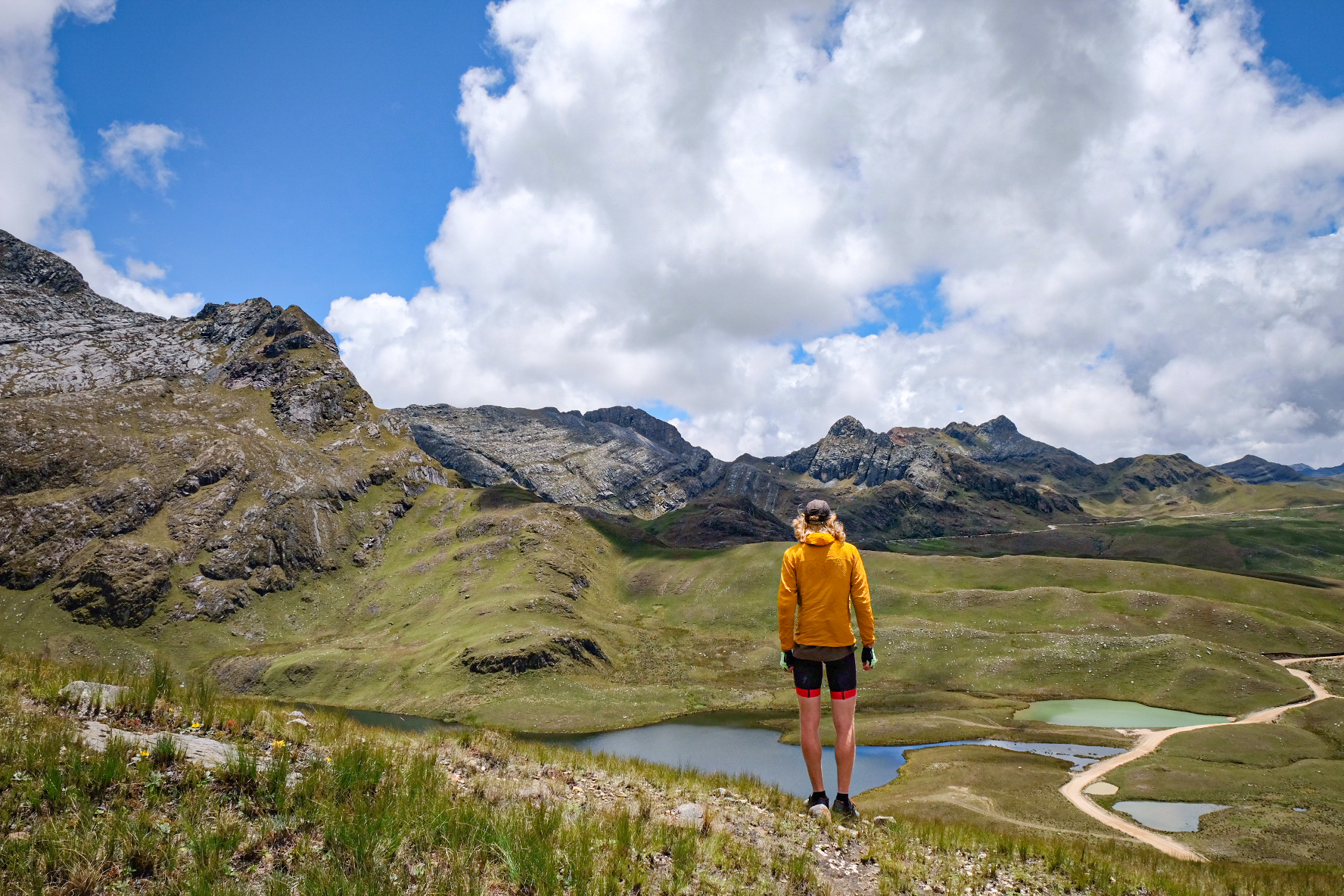
Of all the conundrums we face in a day, it is perhaps ironic that it is this simplest and most common of conundrums that has proven the most complex to solve. This safeguarding of moments of awe and elation against the turbulence that inevitably ensues. To secret away the beauty to a dry nook of our soul while we weather the storm. To take our time, even as the storms loom on the horizon. To be patient and open and genuinely experience the wonders of the day. Which again, sounds simple, I’m sure. But to do so requires holding the apprehension of what’s to come, at bay. To do so requires ignoring the suffering of our past selves and borrowing at heavy interests against our future selves. Our future well-being leveraged for a few moments of wonder. In the Andes, in the rainy season, the house always win. It can never not be so.
But if there is no time for wonder, then why are we even here? If we do not experience the wonder with all our hearts, how will will we ever keep our blood warm once the freezing rain hits? How will these moments of lightness of being, ever compete against darkness to come? Against how exhaustive our knowledge of what even 1-5kms can hold at such altitudes and under rain?
While we were up there, sitting in the sound-of-music grass, eating cookies, absorbing the beauty of the landscape before us, once in a while, our mouths would repeat, like a mantra, the words ‘Estamos siendo estupidos, verdad? Estamos siendo iresponsables, pero…’
And, of course, we were. Being stupid for enjoying it. Yes, of course, now that the day is over, we know the specific shape of the unimaginable trials awaiting us. Pushing our bikes for hours, walking our bikes down rock slopes, getting shot at, nearly getting swept away by a river… But even when they were shapeless, out of focus, unknown; they were never not there. Lurking in the forefront of our mind. Hoping for a better reality, only equips reality with more hope to break.
Which makes keeping hopelessness at bay, regardless, perhaps the most courageous thing we do. In this whole godforsaken expedition. Keeping our sense of wonder open against impossible odds and at tremendous costs to our well-being.
And then, just like that, the picnic is over. The clement weather is tugged from under us like a tablecloth under wineglasses, leaving us fragile and tumbling. And as we straddle our bikes and face the raging black and blue skies, we make our ritual vow:
‘Tenemos que recordarnos de este momento, que estuvimos felices, aunque al final estamos hasta la madre con el día.’
A vow to remember the middle, how happy we were, because by the end of most days, we’ve withdrawn into a place far beyond the capacity for enjoyment. Or something like that. Spanish is more Ceci’s thing.
Once more, as simple as it sounds, its complexity comes from the fact that once the capacity for happiness is beaten out of you, there is nothing left with which to appreciate even the memory of the good times.
So, let me take a moment to say this: we are happy. The experiences we live, every day, fill us to bursting with happiness. The white shining Yang of it all is formidable. To the extent that it would literally take life-threatening experiences to tilt the scales toward the Yin. It would literally take biblical floods and hypothermia and altitude sickness and dehydration and malnutrition and sleep-deprivation and extreme levels of exhaustion to…
Well, you get my drift. If you’ve read Cycling Ecuador, you’re probably surfing on my drifts by now. My point is this: Our journey already contains such a lifetime’s worth of beauty, of experiences, of lessons, of challenges, of successes… in such condensed form that we will be savouring the debriefing process for the rest of our lives. It would literally take getting shot at, now, to swindle the fun out of our experience. But here’s the crux: we are. Getting shot at (allegedly). So puzzle that one out for me. I beg you. Because, what the hell comes next? Getting run over while you try to avoid the dog that has just been run over in front of your very eyes? Getting carried off the side of a cliff by a landslide? Madre Santissima!
But! Also… you know. Maybe just a little bit: Is that all you’ve got, Peru?
Once we crested that loose sand and stones hill, once we turned that corner, we found ourselves swerving around runnels and wahsouts, on a narrow crest with 2,000m deep valleys on both sides. And to be here, at the top of the world, soaking in just how unimaginably lost we are in the middle of this vast unforgivable landscape, is a feeling like nothing on earth. My hands are sweating as I write this. To think you can get lost in your own backyard, and yet here we are in the heart of the Andes, finding ourselves.
And when we began our descent, once our speed could be modulated to reflect the direness of our straights, we made extra quick work of our escape from the men with guns of this world. From the mines of this world, too. From the messy one-upmanship generated by increases in the value of gold. Which in turn increases illegal mining, which in turn increases armed assaults on mines, which in turn increases the armed defence of mines, and downwards spins the spiral and where it will stop, no one knows.
Once we reach the valley floor, we cycle by a tribe of Alpacas defended by fierce dogs. Ceci takes her customary wildlife pictures while I reach for stones to throw and then we move on to the raging river crossing that very nearly washes us away, only to find the same tribe of Alpacas defended by the same fierce dogs on the other side. Who crossed on a nicely built bridge a few metres upriver. Why did we nearly die… again?
No time to wonder, because now its time to batten down the hatches again for the driving rain that accompanies us to our final destination: Mollebamba. An old mining settlement, turned ghost town, whose accommodations are padlocked from the outside. It takes a minute for this to sink in. But we soon catch on that knocking is a futile exercise. We find a potential hospedaje just as the only two street lights in the whole town flicker on. A nice lady opens a room for us, a room that smells like it died, but long enough ago that it almost doesn’t smell any more, but not exactly long enough that you would think ‘Someone can sleep here!’
There are scribbles on the wall of a child’s attempts at alphabet, accompanied by a few words. The room’s backdoor, which doesn’t close properly, leads to a low-ceiling washroom without a door. The toilet is lidless of course and comes with foul toilet odours conveniently pre-programmed into it. Everything pointing to the fact that we’re sharing this washroom with the family next door. And that one or all of them ate something that didn’t agree with them. Only after a day like this, let me tell you. Even still, the park bench outside, currently being pummelled by a punishing amount of rain, was acquiring brownie points at an alarming rate.
The same lady offered to warm up a chicken finger soup for us and having eaten cookies and gummies all day, we gladly accepted. We quickly wiped ourselves down with our quick-dry towels, changed, and walked over to her house. And as we warmed ourselves around our bowls of soup like two ghosts in a ghost town, glassy-eyed and shaking our heads, we started chatting about the mines through which we travelled all day.
The devastation a mine wreaks on the natural world is such a thing to behold that your sense of wonder gets confused. The feeling is much the same as witnessing wildfires consuming multiple thousands of hectares of forest; the sheer scale completely baffles the mind. And to think of it in terms of Northern British Columbian Forests or Cordillera de los Andes mountains is a grotesque mistake in perspective. These calamities exist on a planetary scale. What these calamities put into question are no longer the waterways or wildlife or even entire cities. What these calamities put into question is nothing more nor less than our humanity. Our stewardship of this planet. An argument—writ large enough to be seen from space—that we, as humans, no longer see ourselves as the children of mother earth.
What, then? We’ve moved on from children to what… teenagers? Teenagers who deny their origins, who value indifference over passion, who are aimlessly rebellious, who love bold slogans, who dream of escaping from home, who refuse any and all responsibilities, who are enamoured by easy gratification, who experiment with vice, who make catastrophic mistakes, who seek to escape reality rather than face it, who bully others so as not to be bullied… Quite honestly, the shoe seems to fit.
There is no devastation, that I can imagine, which rivals the sight of these mines. Entire mountains, reduced to terraced rubble. The very mountains which fill our hearts with wonder; reduced to the very mining projects which threaten to spill the wonder from our hearts. And all this because of a simple error in logic at the core of our principal planetary philosophy. This idea of infinite expansion, on a finite world. If we dedicated even one trillionth of the effort necessary for the extraction of minute minerals from entire cordilleras, to the extraction of these tiny errors in logic, perhaps then, they would not expand into our own end. Perhaps then, there would be no one shooting at us or at the sky or whatever™, at the top of the world.
For now, I’m too tired to think. I’ll just content myself with cracking out my sleeping bag to sleep on top of the dusty blankets on top of the mouldy mattress, and with drifting off into dreams of lucumas and Alpaca Baby t-shirts.
For a half hour-ish. Until the food poisoning kicks in.


Tablachaca
‘Qué es eso?’ a little girl says, pointing at my face. And I can’t blame her. I pooped my cycling shorts as we watched our first condor fly by a few hours ago. And odds are, it wasn’t even a condor. It was most likely a zopilote. So, I don’t know what I look like right now, to this little girl, but I’ll bet it’s probably something even I wouldn’t recognize.
‘Es un gringito.’ the shop owner answers. ‘Dile hola.’
I’m navigating my way furiously through the foggy mountaintop town of Pallasca, haphazardly gathering groceries for the next cycling day which promises to be one of the longest of the trip. All the while, Ceci is passed out on a pizzeria table across the plaza. I have to perform a few rounds, going by the same shops twice, three times, to gather a running inventory of the scarce goods on offer. To salvage what food I can from the bus stop kiosk, the children’s toy shop and the restaurant. The fog is so dense that it’s hard to see what is on sale from the street, but once you step in, the store is so overwhelmingly ad hoc, stacked from floor to ceiling with dusty pop bottles and puffed-up bags of chips, that you immediately want to take a step back. And this awkward in-and-out dance all but guarantees that, now, I’m what’s on sale and everyone takes a confused step back from me, then a step forward to inspect my features as though they are overwhelmingly ad hoc, stacked from feet to head with dusty legs and puffed-out eyes, which again, I admit, they probably are. It’s been a day. This is day 5 of cycling in a row of what will prove a 7-day streak without rest, someone shot at us yesterday and today we have food poisoning.
The pizza arrives as I lay out all the goods I’ve managed to scrounge together onto a neighbouring table. I fold half the pizza familiar in half with Ceci still passed-out on the table. The cook generously offers Ceci a coca tea, on the house, to help with her nausea. But we settle for manzanilla, because Ceci, despite all outward appearances, is not suffering from altitude sickness. It was the soup, remember? And what’s more, we sorely need a good night’s sleep and something about cocaine before bed sounds anti-conducive to catching zzzz-s. Chamomile tea on the other hand is known for its digestive and soporific properties… and, this just in, apparently as an emetic because here goes Ceci, pale as a ghost, booking it around the table, out of the pizzeria and disappearing into the fog. Like a ghost who’s seen a ghost. I quickly settle up, awkwardly grab all our mix-matched snacks and dash out after her only to find her projectile vomiting into a 25% grade cobblestone road facing upslope, so that yesterday’s soup slides down towards her shoes.
It’s been one of those days. From the very millisecond I woke up, I knew it was going to be one of those days. One of those days when even just closing your eyes, just for a few brief breaths, brings you worlds of relief. Enough to wrap your mind around moving on. And if you look at the map of what awaited us, it looks like a bunch of really tight squiggles. Like someone skimmed the skin off the maps to reveal the miles of bunched-up guts underneath. Only 40km, but when you look across the valley, you can see the squiggles. Twelve hundred metres of them, smooshed into the last 20 kilometres.
‘Que es eso?‘ The little girl’s words echoe in my mind.
And it’s not the first incident of this kind, either. Barely 2 days ago, in Huamachuco, while sitting in the main square, minding our own business, taking in the sunset, photographing the dozens of shrubs and bushes trimmed into various shapes such as women in traditional attire complete with their huge hats and wide skirts; a little girl came up to me with her mother and said, ‘Y ese qué? Está bien feo. Es un barbón…’ and left. Indignant at my beard and general ugliness. Which consequently, made us realise that, indeed, every single man we met in Peru is neatly shaved. Perhaps the odd policeman with a moustache, but not a beard in sight.
So, I guess it’s not all the chicken finger soup’s fault. What was in that soup anyway? Zapallo squash, sloppy tallarin noodles, a chicken drumstick. We never did figure out what exactly made us sick. None of these things were especially revolting to us in the aftermath, so it is hard to say…
‘Qué es eso?’ I say, a full night’s sleep later, pointing at the landscape we face.
We’re standing on the edge of a canyon, our bikes balanced between our legs like kids on the edge of a half-pipe. An 80-kilometre long, three-thousand-metre deep half-pipe. And get this: For free.
Of course, you might think that we paid for it what with all the uphill we’ve done to reach this point. What with being sick and all. But that’s not how it works. The Andes, remember? Not all downhills are born equal. If you think you can’t pay for it both ways, you’ve been richly misinformed… I would certainly not be caught hypothermic investing all my efforts on the uphill with the idea of cashing-in on the downhill. No señor. Okay maybe we did, once or twice, get fooled. The uphills in Peru have proved so gradual, especially when compared to Ecuador, that we might have found ourselves, once or twice, cantando victoria with only downhill left to the day; only to find ourselves brakes jammed, skidding, bouncing uncontrollably, walking sections and even doubling back to find another approach.
Which kind of jams a wrench in the spokes of the main benefit of cycling. Why, after all, would you haul a 35kg loaded bike up a hill if not to reap the downhill? Between you and me (but not Ceci), we might as well make it a hiking trip at that point, don’t you think?
But today? Gratis. Our number one, funnest cycling day of the trip. And possibly ever. And whether it is riding at the top of the world, on the brim of the canyon or riding at the bottom of the canyon, along a roaring river; that ends up winning as the absolute cycling highlight of the trip, is entirely beside the point. We got both.
The feeling of standing there, in the wind. One day I’ll write a book about it. The vast crayola mountains expanding outwards in shades of oxidized copper, hues of rusted iron; the pepper green of cacti, peppered across steep hillsides, the blue of faraway cloud-shaded mountains. Expanding outwards from the epicentre of our awe. Or so it seemed at the time. Each mountain, each cloud, near and far, shifting at its own pace around us as we began our descent. Smiling in the wind. Smiling while freefalling. Smiling.
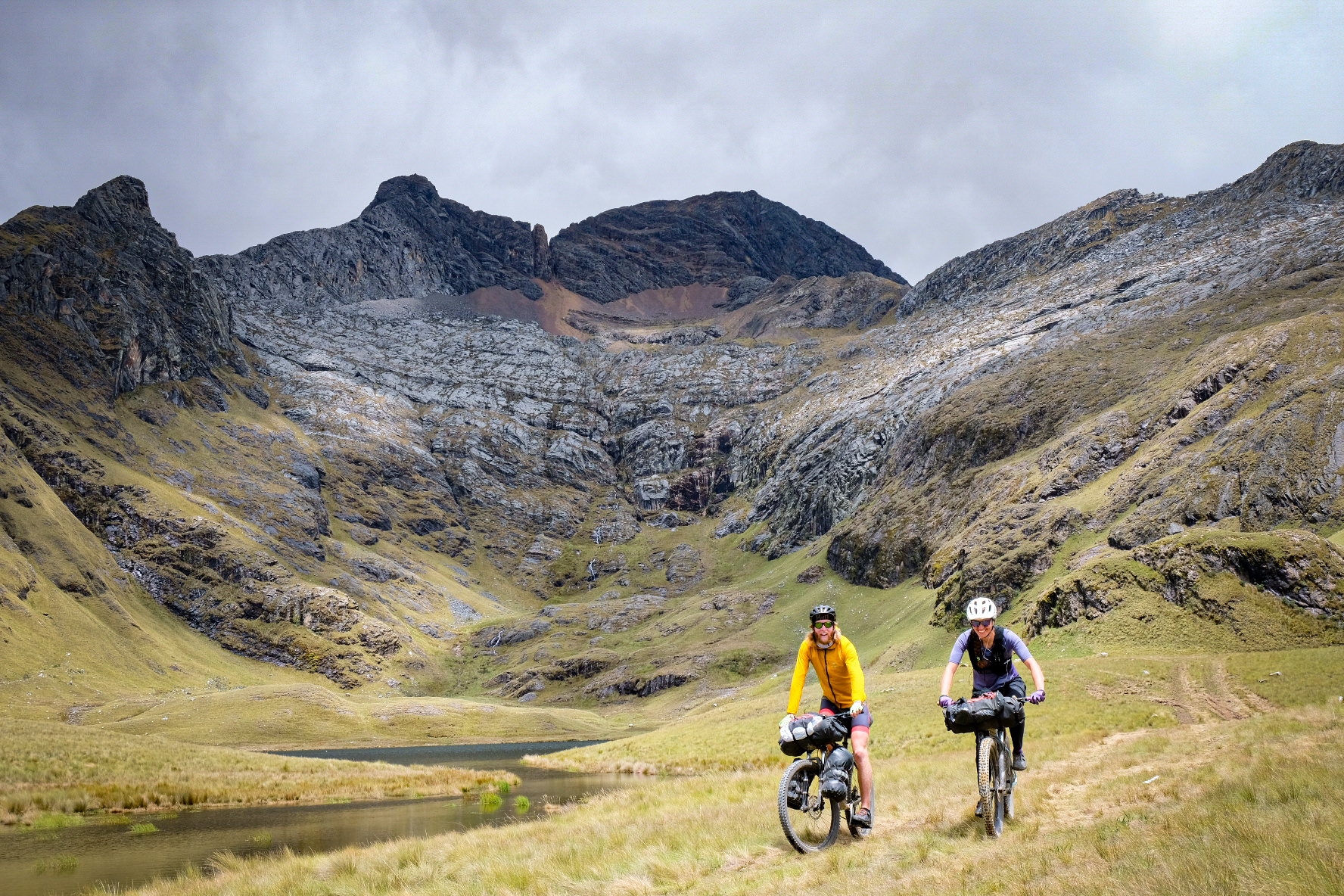
Our path led us deep into the narrow canyon, whose floor held just enough space for the raging river and us. The waters so rich in sediment that its grey flow was almost clay-like in consistency. Pebbles and rivulets of sand fell constantly onto the road from the impossible heights of the canyon walls above. The road itself was strewn with boulders and stones, leaving us to wonder at the house-sized boulders precariously balanced on nothing at all, hundreds of metres above us. Hmm, we thought. Curious the resemblance between the road boulders and the cliff boulders. Uncanny even…
Throughout the day, we crossed innumerable tunnels whose depths were as dark as their exits were bright. Ceci always reaching for our headlamps, excited for the speleology to come. Excited to justify carrying the extra weight of our red-flashing saddle lights across the Andes.
Fifty kilometres without pushing a pedal. Sixty. Through the darkness we smiled, through the light, through the… wind.
And then, the wind. Of course, how could anything be entirely free. In the Andes? Have you learned nothing? With 20 kilometres of downhill at a soft 2-4% grade: a 50km/h headwind. So, we did what we do best. We shrugged. And pushed on. Even riding in a tight formation, we barely made any progress against the wind. However, as always, the destination was as far as we get before our legs give way or before nightfall (or not too long afterwards). And having ridden 60kms already, the wind ate very little into our happiness.
The wind was still blowing strong when we reached the small desolate highway-side town of Chuquiscara (literally ‘Chucky’s Face’), where we stopped for a quick almuerzo and resupply. Chuquiscara has developed at an ‘L’ in the road where two highways meet and when we set off again, it was in a perpendicular direction, which in itself guaranteed little inasmuch as a switch in fortunes. Aaand yet…
In the Andes, when it rains, it pours. Metaphorically and literally. And in both cases, it is only so very rarely that it plays to our advantage. So, when we took that ‘L’ in the road, we were fully ready for the knife to cut both ways. To slide off of Chucky’s knife straight onto Chucky’s knife, so to speak. Just what it was about this particular little hard patch of days that made some guardian angel take notice, is hard to say. But when we veered off the knife, we suddenly found ourselves in the clear. What fountain of pity we breached into that would allow both 80kms of downhill and a 50km/h tailwind, we will probably never know. It felt so strange that we didn’t know how to feel about it at first. Somehow the two valleys were such monuments of nature that despite heading in perpendicular directions, each channelled the wind in exactly opposite direction.
The elation. Let me tell you. I think our elation every time the wind gusted us uphill is by far more pitiful than any getting shot at or any food poisoning. And I say this in a positive way. For the first time, the poor aerodynamics of our overloaded bikes worked to our benefit. Benefit! What a word! I’d almost forgotten how glorious it sounds when combined with the word ‘Our’. Not a single drop of rain fell that day. So much so that the motto of the day became: ‘When it doesn’t rain, it doesn’t pour.’ Truly poetic stuff.
We would ‘Wuhuu!’ and ‘Yuuuu!’ every time a gust of wind would carry us on its shoulders. With such pitiful joy that I wept a little with every exclamation. Just like when you laugh so much you pee a little. The joy of finding ourselves worthy of pity. Not even worthy of a helping hand or of love. Just worthy of pity. The pitifulness of it, still makes me want to cry. So many days of small asks, of small prayers being denied. To the point of feeling utterly alone and alienated and unwanted and forgotten. So many days of kilometres not adding up, of bad surprises around every corner. Eighty kilometres, ninety, there was so much oxygen in our blood from being at low altitude that we were allowed to feel like athletes again; that we could push without immediately acquiring an oxygen debt. One hundred, one hundred and ten, just how much the trip had broken us down was suddenly laid bare for us to see. It felt like we were surfacing from a bad relationship. Or receiving the first warm ray of sunlight after a long dark Canadian winter. One hundred and twenty, one hundred and thirty. The wind gave and gave until the last uphill of the day which led us away from the river, away from the canyon walls and into mango groves.
There was something heartfeltingly bittersweet about the wind’s leave-taking. Like bidding farewell to someone who you will never see again. A celebration mixed with mourning. Like an unexpected visitor in a dream who returns to having passed away upon waking. It’s both a generous gift and a profound loss. A feeling for which the heart knows only gratitude. Whoever remembered us, whoever lifted us from our misery during the last 40kms of the day. Thank you from the bottom of our hearts.
One hundred and thirty-five, the mango groves left us dreaming of mango juice. Twenty litres’ worth, to match our tremendous thirst. We reached a small village with a renewed hope for our relationship with the world. The sun was setting when we reached another cross-roads and, smiling with anticipation, we asked for mango juice at a local stall. ‘No hay.’ Smiling, still, we reached the next kiosk. ‘No hay.’
Ceci and I both put on our best ‘Como crees?’ faces which we’d already amply practised when we got shot at two days ago; and proceeded to ask where such a needle-in-a-haystack as a glass of mango juice might be procured in such a fine hilltop village, surrounded by leagues and leagues of mango groves with mangoes so ripe and juicy that they literally fell of the tree and were left to rot in the street, their perfume saturating the evening air.
‘No hay.’
Just like that, we awoke from the dream of 80kms of downhill with 40kms of wind-assisted uphill, only to find ourselves… in Peru. Peru we love you, but we know you by now. You’re one of those pince-sans-rire types, one of those pinche molestón types, and if you speak neither French nor Spanish, what I’m doing to you right now, is what Peru does to us. Frustrating our every attempt at any sense of meaningful release. The mangojuicelessness of the whole entire village, you couldn’t invent that stuff. And yet, it is so gloriously symbolic of our time in Peru.
Magojuicelessness in the shape of restaurants that are closed because the owners are out to lunch; of guesthouses that are closed because the owner is sleeping in Lima; of stores with signs that read: ‘Attención las 24 horas!’, which are invariably closed for the duration of our stay; of ATMs that don’t have money until someone deposits, which no one does for fear of never being able to withdraw… Mangojuicelessness. In a sea of mango groves. Peru’s entire national pride is based around its 1000+ varieties of potatoes, we spend days cycling next to the purple and white flowers of potato plantations. And all you can ever order are French Fries. White. Golden if you’re lucky. So much so that what began as jokes, soon became rules to live by. Find a ‘Traditional Peruvian’ dish or snack you like? Buy ten, because you’ll never see it again. If, by some miracle, a restaurant or a shop is open, don’t even stop to sneeze or tie your shoelaces; run! If the sun peeks a ray between a sea of clouds, drop your bike in a ditch and take a picture. I am legitimately mournful about the thousands of breathtaking sights we didn’t get a chance to capture because the moment we tried to sneak up on them, storm clouds moved in or a truck scared away the wildlife or it started to pour on us.
So… we settled on ice cream. Mango juice just wasn’t in the cards. And even though there was mango ice cream on offer, we were done with mangoes, by then. There’s just so much absurdity a person can take. Just so much mangojuicelessness. And besides, nothing in the whole wide world can ever rival the taste of lucuma ice cream. Lucuma anything. Lucuma, my love. The number one best fruit in the world. Like… like mamey, but better. Sit on that for a minute. Like mamey, but better. Never tried mamey? Lo siento muchisimo, but there is nothing I can do for you. Here… as a consolation prize, try and imagine the creamiest softest caramel you’ve ever had, times 20 and in fruit form. Make it a tiny bit granular on the tongue and eeever so slightly bitter when it coats the back of your throat. That’s mamey. Now, imagine that to the power of 4. Voilà. Lucuma.


On what reserves of faith in a better world we still possessed, we cycled-on out of the village and into evening’s last glow. Several spots along the way might have served well to set up camp for the night. But something about our day made us push-on just a little more until we found that spot. And if on any day that perfect haven existed, we felt that it would be on a day like this. So we followed our intuition, powered on the vestiges of hope gifted us by our guardian angel. So we carried on into twilight and found a beautiful, secluded area next to the river, surrounded by flowering cacti. We set up camp by the stars. The river too treacherous to bathe in, especially in the dark, we towelled off the day’s dirt with out quick dry towels and called it quits.
Not a single drop of rain fell that entire day. Not a single drop of rain fell that entire night. Such was the alternate reality of the day, that we never even felt sick. A mere day after expelling our innards in new and exciting ways. A miracle of miracles when you think about it. Especially when you take into consideration la cruda (hang-over) that awaited us the next day. The dehydration, the lack of food, the food poisoning, the sunburns and the 140kms and 1,260m of uphill of the day prior. And the general Mangojuicelessness of it all.


Laguna 69
‘Hola?’
‘Pachmamita..?’
‘The God you are trying to reach Pachamama is currently unavailable. Please leave a message after the…’
We’ve been cycling the Huascarán loop in the Cordillera Blanca, waiting for Mother Earth to work her timely little miracles and allow us glimpses at snowy mountains. It’s in the name. So it can’t be that much to ask. White Mountain Range. And yet, what we have here is a classic case of the greys. All over. Pachamama must be truly saving up for something espectacular because, so far, all we’ve been able to glimpse is the lowest-most snowline and even that is mostly obscured by a skirt of heavy grey clouds and there’s just so far you can twist your neck to look up under it before someone calls Chief Constable Llama to come and kick you in the what am I even saying? I swear this metaphor won’t make the magazine cut. But since you’re reading this for free… what do you expect? First-draft metaphors is what. In the magazine, I’ll probably try and spin it like: the inclemency of the weather forces even the mountains to take cover under plush grey blankets of the finest baby alpaca wool… Boom. Metaphors.
Anyway, we took one day off. Unito. After a seven-day streak of cycling days, the last three of which were made somewhat unpalatable by food poisoning. (*free magazine-grade metaphor sample.) After puking, Ceci’s been doing just fine, but to be fair, I ate twice the portion of the caldo de gallina that made us sick. So, when we set off into the mountains again to visit the heights of Parque Huascarán, I was fairly certain that I had recovered.
However! Surprise surprise. What with the 3-day war of attrition I had waged on my body by being unable to eat and losing all sorts of electrolytes the-hard-way and biking a total of 230km with 4,125m of uphill; the trench I had dug for myself was so deep, that all the shovelling-in of food and drinks that unito day-off can offer, replenished me about as much as a fistful of dirt thrown into a hollow grave.
All I had really managed to do was to stop digging.
So when we set out on that first day, we might have left from Carhuaz at 2,750m above sea level, but from the depths of my trench, I started the day barely breaching sea level. And while it might seem like we went uphill that day, 2,400m’s worth and up to the second-highest point of the trip, at the time, 4,750m above sea level and through the highest tunnel in the world (if you disregard the actual highest tunnel in the world which is in Colorado); I was busy giving the Mariana Trench a run for its money.
Of course, Ceci noticed from the get-go that something was off. Lucky for me, there’s a rule in professional cycling that if a contender for the General Classification crashes, you can’t choose that moment to attack. And while I have no idea what you would call what I was doing that day on the bike, I’m fairly certain that it can be summed up as a complete and utter crash and burn. And by God, if you think I wouldn’t juice the devil out of that detail, boy would you be Ceci. She never saw it coming.
‘Todo bien?’ she said. ‘Todo bien?’ like that, over and over.
Meanwhile, I’m muttering in my deep dark trench, 3,750 metres below her, by now and experiencing barometric pressures so strong that my head kept wanting to implode; something to the effect of ‘Even… my worst days… still have to… more weight than you… all the camping gear… still have… cut the wind…’
And meanwhile, it starts to rain and water’s flooding into my deep dark trench, pooling around my feet, rising, and still, somehow, I can hear Ceci saying from 4,289 metres above, ‘Todo bien?’ and ‘Todo bien?’
And that’s when something broke inside me. Like a steel guitar string wound up to absolute, bat-echolocation pitch… PACLOW! And, in the tinnitus aftermath, I realised that one never knows the extent of one’s true potential until one reaches the absolute limit. This was the limit. And the following was the manifestation of my true potential. And if you thought that I wouldn’t find a way to finesse my way out of this nightmare, you would be Ceci. She never saw it coming.
‘Que?’ I said.
‘Todo bien?’ she asked.
‘Que?’ I said. And by this time it might have become clear to some of you the stroke of grand-master-level table-turning this represented. Not Ceci. Not yet. She still didn’t see it coming. So, she said:
‘Todo bien?’
And I said:
‘Que?’ Oh, yes. Now it’s sinking in. That age-old trick Ceci always whips out on these cycling trips. The ‘It’s the wind’ trick. The ‘A truck went by’ trick. And so on.
And something about this sweet sweet payback for all the years of having to repeat everything I say twice, thrice, quatrice times, helped me get my wheels under me. Sneaky, I know. Mastermind level sneaky.
Still… there was work to do.
Luckily, at this point in the trip, a point when our utter exhaustion equals our formidable fitness, the difference between suffering and suffering becomes as slim as, say, the difference between waterboarding and water deprivation. In result, of course, because in technique, one is indubitably more eco-friendly than the other. And what’s more! Thanks to the everything-must-go liquidation of my entrails over the last week, thanks to all the nausea and dehydration, the difference between my body mass and that of a professional cyclist was about as slim as a… professional cyclist? Not too too surprising seeing as this trip is basically a game of never-have-I-ever brought to unconscionable lengths. Never have I ever been this cold. Never have I ever been so exhausted. Never have I ever been so oxygen-deprived. And now, never have I ever been this skinny.
I’m not quite sure how I managed that first day, to be honest. Almost passing out at every zig and every zag in the road, of which there were a dizzying amount. But after a few roadside catnaps, after a few growls at Ceci’s attempts at conversation, suddenly, here we were: the highest tunnel in the world (if you only take into account the years between 2013 & 2019). At an altitude of 4,750 metres, if your name is Ceci. Meanwhile, I was closing in on minus 5,000 metres of altitude, all the dials on my dashboard spinning madly, the glass shattering. Ask Ceci, she’ll tell you. I was yellow in the face and almost deep-sea fish translucent. You could practically see my blood vessels bursting like fireworks in magnificent hues of blue and red.


And then, the utterly unexpected happened. We were suddenly engulfed in a crowd of cyclists. A crowd of first-time cycle-travellers, led by a first-time cycling-guide sussing-out the market. Boy that’s a lot of hyphens. A crowd of cyclists who could not believe that we’d swallowed up that whole climb in a day. What were we, some kind of Olympians?
And let me say something, here. Heart to heart. It felt good. There. That should tell you the level of hurt. That should tell you how much we needed a win. But it’s more than that. Here’s the thing: Who’s going to say ‘Guau!’? (Which believe it or not is Spanich for ‘Wow!’) If it’s just Ceci and me, I mean. What’s so special about what I’m doing, if Ceci’s doing the same? And vice versa? What’s so special about a sinking ship when seen from the vertical poop deck of another sinking ship? (Boat Anatomy 101: A poop is like… well: a poop. If it’s horizontal, it’s likely a floater. Which is a quality you generally look for in a boat. If it’s hanging vertically, it’s likely sinking.) I mean, you don’t even need two boats, even on the same boat it makes no sense.
What does the sinking Titanic passenger say to the other sinking Titanic passenger?
‘Wow, you soo rock! What you’re going through right now? Just wow!’?
And let’s be honest here. What we’re doing here? Day in day out? We’re sinking. We’re trying to keep running after the GameOver sign occupies half the screen. Our Andes ship started sinking the moment we started cycling. All we’ve been doing is trying to emulate that legendary Quartet that kept playing in the concert hall of the Titanic even as tables and chairs came flying at them and shards from the shattering chandelier took their eyes out and water started rising up to the their elbows and piano keys and through porthole they can see people welcoming death by jumping from the bow of the ship, screaming ‘I have no regrets!’ or… or ‘I thought they said it was unsinkableeee!’ or, or… or ‘The other day you had spinach in your teeth and I thought to tell you but then I didn’t and then it was to laaaaaate!’
Plooksh!
And so as much as it hurts to say it, those cycle-travellers telling us we were some sort of half shark-alligators, half-robots on bikes, for doing what we do every day but way slower because of the whole Mariana trench analogy; it felt good. It felt good. As though all those cyclists patting us on the back and offering us food were Kate Winslet telling us that we should ‘Hang in there, Jack’ with steam coming out of her mouth and her, if I remember correctly… red-ish? hair frozen to the… was it a door?, even though, by then, we can’t listen because we’re frozen-to-death dead. I know, I know, Kate Winslet again. But it’s true: Seeing the enthusiasm with which they were doing what we’d been doing day-in day-out, for nearly two months straight, and them doing it for the first time; kind of kindled that old flame we used to have when cycle-travelling used to be fun and we used to spit off the bow and leave sliding fingermarks in foggy car windows, like all the time. And, I’m sure you know where this is all going, but it’s waaay too late now: To see our experience charcoaled-in in such glorious detail by our new friends, all the curves in the… hum… road, all the hairy… hum… situations, all the really cool cool blue diamond necklaces… hum… for whose corresponding metaphor you will have to buy the magazine; it really helped put things into perspective and capture the moment for us in a nude light. Did I say nude? Anyway, there. Pfiooof! Am I glad we made it safely off that sinking metaphor!
Once we bid our farewells and carried on through the highest tunnel in the world (aaalmost), it was like they’d unstuck our frozen hands and released us to drift into the dark depths of the highest (don’t quote me on this) tunnel in the world. And it all happened so fast that like Leonardo, who was too dead to ask why-oh-why couldn’t she just have left my hand on the door so as that my body could be later discovered and buried as is only Christian; we were too dead on our feet to remember to fish out our headlamps.
The Punta Olympica tunnel is a 1.4 kilometre-long lightless tunnel. Open to traffic. But we were suddenly young again! And full of spunk. And so we took it in stride. And in case you thought riding through a tunnel would provide shelter from the rain, think again. Knock knock, yep we’re still in the Andes. As we cycled in pitch-darkness, we went through waterfall after waterfall, cascading through the stone of the tunnel ceiling. Whiiiich, might tell you more than you want to know about the structural soundness of the whole deep dark hole in the mountain.
And it soon proved to be the best moment of the whole deep dark hole of a day. Maybe it is because, at last, the state of my outer-world so perfectly reflected the state of my inner-world, or maybe it was the sheer adrenaline, but soon we were yelping like cuyos and echo-locating like vicuñas… In many ways, never as alive as when so near death. We ducked and hugged the greasy dripping walls every time a truck came barrelling past, honking its deafening horn, and sped immediately after it to make momentary use of its fog lights.
When we came out the other side, into an entirely new valley, the sun came out too (for a brief moment). The heat of its rays lifting wisps of vapour from the black tarmac of the road. Lifting our spirits, too. One long winding descent awaited us and with every metre of altitude loss, my deep dark trench lost some of its depths. On the one hand shattering dreams of reaching the deepest point known to humanity, on the other restoring the knowledge of my own deepest humanity which at some point had been shattered beyond my wildest dreams.
‘Hola?’
‘Pachamamita…?’
‘The God you are trying to reach Pachamama is currently…’
Day 2 in La Cordillera Blanca. Still quite confident in our belief in Pachamama’s guardian-angelship of our journey, even if in her own, admittedly Jesus-take-the-wheel way; we kept our eyes peeled, all day, for a scenic snowy mountain great reveal.
‘Hola?’
‘Pachamamita…?’
‘The God you are trying to reach…’
A bit shaken in our belief, after not a single mountain summit chose to reveal itself, yet, on this, our third day in Parque Nacional Huascarán; we kept our eyes glued to the grey horizon. And, as the day progressed, all signs were pointing towards Laguna 69 as the oasis of pristine sight-seeing weather. A crystalline turquoise alpine lagoon, surrounded by pure white glaciers… this had to be it. The window of all windows into the white wonders of the Cordillera Blanca. All our waiting suddenly not for naught. Surely Pachamama, in all her wisdom, was saving what tiny scrap of good-enough weather she could muster for this most magnificent reveal.
So, we biked all the way to the hiking-trail entrance; biked past the last tourists of the day on their way back from the laguna, balancing our weight on increasingly technical trails. And, when the trail became entirely unbikeable, we decided to push the bikes. We made it less than one kilometre before this too proved way too arduous and inefficient. So, we ditched the bikes in the bushes amongst gawking cows, unloaded all our bags and began hiking up the trail in the rain.
One bag under each arm, backpacks on our backs, to which I’d carabinered my two front-suspension drybags, we started navigating the increasingly steep and slippery trail in increasingly inclement weather. Thunder to the left of us, thunder to the right, we rallied on, only pausing every so often to adjust our grip on the slick and slimy nylon of our bags. Fingers growing increasingly frozen, increasingly numb, we waddled for hours uphill, like… like clumsy scarecrow christmas-trees, with about 20 awkward kilos of weight each, split into too many bags, each bag with its own ungainly shape and point of equilibrium. Swinging and bouncing according to each its own rhythm with every lumbering step forward. And even after hours of biking at altitude, followed by hours of hiking at altitude; when we, at last, reached the lagoon and found it utterly whited-off the map by a dense fog—never mind the promised snowy mountains and glaciers—we somehow held onto our faith.
‘Mornings.’ we said, as we hugged each other in the rain. At 4,600m above sea level. Near dark. Without an exit strategy. Without a soul knowing our whereabouts.
‘Mañanas.’ we agreed. Mornings never failed in offering ephemeral but usually very clear views. As for this very evening? There was no time to lose. The storm clouds rolling in were so black they were blue. So, we immediately started scanning the area for a place to set up camp.
The shore of the 14-hectare lagoon being mostly a boulder field, the only true camping spot we found was a tiny, relatively clear rectangle of dirt right next to the water, perhaps a meter wide and half a meter higher than the surface of the water. Right next to the sign that read in big bold letters: ‘¡Prohibido Acampar!’
And what’s worse, there was no way to ‘No Speaky Espanich’ our way out of it, what with there being a big bold, blood-red, crossed-out circle encircling a big bold, blood-red, drawing of a tent. Right next to ‘¡Prohibido Acampar!’
Now, I don’t know if you know this, but we’re here, now, explicitly because we read that camping was allowed and that the campsite was reachable by a tough but doable hike-a-bike. Now, here we are, a few hours of hiking from our bikes, about half a day of cycling away from any civilisation; the sun has already set and the gathering storm is warning us in no unexplosive terms that it will probably not be able to hold it in much longer. And that we’re camping right next to its ideal toilet. So, needless to say, we busy-beed about, frantically setting up camp there and then. Yes, right next to the sign.
With about three seconds to spare before absolute mayhem broke loose, we froze in place and watched as an Andean Fox circled our camp. The Andean Fox also froze in its steps, tilting its head sideways at the exshtrawrdinary BBC planet moment we represented, Ceci and I. It’s ears angling left and right, like satellites, waiting for an Andean Condor with cargo pants and bushy eyebrows to whisper: ‘The Andean pilgrim. An exshtrawrdinarilyy rare sub-species of humans. Nearly impossible to sight at this time of year. Only 1 in a million even attempts this journey during the rainy season. And due to exshtrawrdinarily harsh conditions at 4,600m above sea level, very few survive…’
For us too, it was like one of those movie moments. When the main actor—who got the role after Kate Winslet turned it down—turns to see a white horse neighing in the distance and when the actor-who-is-not-Kate-Winslet (AWINKW) raises a hand, the horse turns and heads off into the sunset. And that’s how AWINKW knows that her long-lost love has moved-on to a better place. Or something. I’m not exactly sure on the details of just what it means for us, in this scenario. But the fact that even the wildest of Andean fauna was heading down the mountain to seek cover, was certainly not a bright, shining omen of hope. We hammered the last two tent stakes into the ground and plunged inside the tent just as the storm unleashed its fury on us. What happened next is easily the most intense hailstorm of the trip. Amongst very notable contenders.
And I won’t pretend to know what you believe, but despite having listened to people my whole life trying to convince me that hail is great because at least you don’t get wet; the truth on the ground, as is often the case, is the exact opposite. Hailstorms always smuggle rain. The mechanics of it are not always obvious, but trust me, I’ve worked under hail for the past 10 years. It’s ice, but you get clandestinely soaked.
And again, who knows what life has taught you, but my life has taught me, in no unexplicit terms that hailstorm thunder is by a landslide the most petrifying thunder known to science. Like ice castles shattering; like glass being hammered inside a megaphone. It’s cataclysmically loud and when it explodes within a kilometre of your tent, at this altitude, you feel utterly and ludicrously naked to the elements.
And by the time the hail covers the entire boulder field in white, by the time it recedes into rain; we are watching whole, entire, full-fledged raindrops falling inside our tent. Inside our tent. Inside our tent. It’s 3°c and falling, we’re both still wearing our filthy cycling clothes, too awed by the elemental fury that the Andes has just unleashed upon us; too shocked by the implications of the constant rainwater infiltrating our tent from too many points to count; to even think about getting changed.
Here’s the thing. While I’ve been spinning webs around the cycling part of our experience, a parallel story has been unfolding in secret. A camping story, starring our tent. A Mountain Equipment Co-op tent we bought for our circumnavigation of Cuba cycling-trip in 2018-19. We used it twice in Cuba, 3 times in Mexico and once in Canada. It is, by any reasonable measure, brand new. In South-America, so far, we’ve camped once under a roof, twice without rain, once in snow and once in the rain (but we brushed-off the drops falling inside the tent to condensation). So by the time Laguna 69 plunged its fork into the wet salty croutons of our backs, our ‘Et tu, Brute?’ could be translated into: ‘So… not condensation after all?’
However, this parallel story bed was of our own making. So the only thing left to do was to… make it 10% less wet? We stuck our wet raincoats between the roof and the mesh ceiling of the tent—like two cute Frozen II band-aids over an iceberg-size tear in the side of our sinking ship—and surrendered ourselves to the mercy of…
‘The god you are trying to…’
Okay, fine! We’ll find our own solace, then. A little game I like to call ‘Whatever bro, what’s the worst that can happen?’ (WBWTWTCH for short.)
Come on, let’s just play a round and then we’ll quit. You’ll see it’s actually quite fun. Close your eyes and take everything you’ve learned about our current predicament and ask yourself WBWTWTCH? Now, let’s see if your answer matches ours.
Whatever bro, what’s the worst that can happen? Laying in my filthy wet sock of a sleeping bag, on my filthy wet sock of an uninflated sleeping mat, my thoughts went immediately to the tent zippers. See how fun it is? Everyone always comes up with a different answer. Why the tent zippers, you ask? Because, how easy would it be to unzip the tent door while also drowning? Why the drowning? Because, how big would a chunk of the receding glacier have to be if it fell from, say, 300 to 800 metres up, off of the sheer cliff straight into the lagoon, for it to cause a tsunami big enough to swallow our half-a-metre sandy buffer and swipe us into the lagoon? Or off the edge of the cliff? Or into the boulder field? My guess? Maybe, 15 by 15 metres?
Since we weren’t going anywhere until morning, my guess was that Ceci wouldn’t like my answer. So, I unzipped the edge of each tent door and I kept my answer to myself.
Meanwhile Ceci’s putting her own spin on the game. She’s going for more of a ‘WWJD?’ angle to our plight. And since I’m pretty sure the answer to that question is always, ‘He died for our sins,’ So, What Would Jesus Do? I’ll let you guess whether or not she spent the night thinking that she would die for hers. That is to say, she was leaning more towards a general ‘Vamos a morir y va a ser mi culpa.’ attitude. Which—give onto Caesar and all that—is true. If we die, it would be 99% her fault. Ninety-nine percent because, after all, I married Ceci. And while I never imagined that saying ‘Yes’ in that random lady’s kitchen in Nelson, Bc, with my brother and soon-to-be sister-in-law as witnesses, would lead me precisely here, to death-do-us-part ourselves by way of tsunami… I guess you could say some part of me always knew we were destined to a Ceci-Danger kind of final destination.
The other 99%? Well, I’m sick, remember? I weigh probably about 68kilos, by now, and when I take my shirt off, it’s like, well, a wet t-shirt contest at a skeleton convention. So, I’ll let you guess who was the one who insisted we hiked up to camp at the lake. I’ll let you guess if it rhymes with Pepsi. But here is where Ceci’s brain and my brain compute differently. Since either way you looked at it we were probably going to wake up dead, I thought to myself: I would rather die doing something I’m passionate about. And so I turned over in my wet sock and fell asleep. Ceci? At the prospect of waking up dead? She decided she wouldn’t die without a fight and spent the rest of the night wiping raindrops and tears off her face. Take that death!
At the crack of dawn, it was still raining. We ate breakfast inside the tent, which all things considered, was not all that different from eating it outside the tent, in the rain. A creature comfort, I guess you could say. If the creature happened to be a toad, or a fish. Now! I have no doubts you’ll think it cruel of me to say this, but what the hell! This moment is one of my fondest memories of the trip.
Ceci, crying over her oatmeal. Everything soaking wet, we look like two wet sandwiches in two wet ziploc bags. Spoonfuls of yellowy mush (lucuma yoghurt and quick-cooked oats) going in, sobs coming out. And every time Ceci shifts, one of the many puddles in our raincoats overhead unleashes onto her head. It’s all so cartoon-like that it almost feels like it’s not happening to us.
Meanwhile, I actually woke up feeling not sick for the first time in more than a week. So, I run 3 laps around Ceci and the next thing you now, there being no view to be savoured, no window upon glorious white mountains; we’re hiking out. And as we unwound the knot we wound the evening prior, we had time to reflect on the whole misadventure.
‘The God you are trying to reach Pachamama is currently unavailable.
Please leave a message after the… Beeep!’
‘Hola? Pachamamita..? Mira, ya entendí. Sí nos hubieras enseñado las cimas nevadas de tu cordillera blanca, habríamos empezado a pensar que estamos encantados, o especiales; que con el simple hecho de quererlo tanto, nos merecíamos montañas. O que con el simple hecho de sufrir, nos las ganábamos. Fue una fuerte lección en humildad pero creo que nos hizo bien. Entonces, muchas gracias.
‘Ceci y Etienne.
‘Y por favor no escuches todo los mensajes previos…’
‘Hello? Pachamamita..? Look, I get it. If you had shown us the snow-capped summits of your Cordillera Blanca, we would have begun to think that we are somehow charmed, or special; that by the simple fact of wanting it enough we deserved mountains. Or that by the simple fact of suffering we somehow earned them. It was a strong lesson in humility, but I think it did us good. So, thank you. We miss you.
‘Ceci & Etienne
‘P.s. And please don’t listen to all the previous messages…’
And since we’re in the business of thankful forgiveness. Ceci, danger of my life, I forgive you too. Whatever death might have awaited us up there it would never have done us part. (Especially when you consider the whole zipper hypothesis.) We would have gone down together, no matter what. What’s more, you paid me back amply with the whole crying over oatmeal thing. What’s more, more, I think it is your gift as a passionate person to show, by example, just how far one needs to go to fulfil one’s dreams. To make the rest of us realise why our dreams remain dreams while yours are never long on the bucket list. You are willing to follow through to the point of not wanting the dream any more. This is not a bug, but a feature.
I wish I could say the same about our tent. Once dry, we submitted the tent’s roof to a waterproofness test. With a spray bottle dialled down to the thinnest mist. Less than a sneeze’s worth of spray. Fffsss fffsss. And when we slid our hands under the fabric, it came away soaked. Which is about as waterproof as a white shirt at a Hooters convention. Without any of the benefits. Now, just how that is possible is beyond me. These tents should be able to withstand several pounds of water pressure. Were it to have been any less hydrophobic and it would just be straight-up water. I guess, at least then, we’d have a valid reason for waking up dead!


Trululu
‘Cerebrooos!’
We’ve just crested the mountain we’ve been working on all day. Sixty kilometres of uphill, accumulating over 3,000m of vertical gain. It took us seven hours of cycling, that is to say, seven hours of saddle time, to reach this spot. Never mind the breaks. Which, considering that we’re fresh off a rest day and strong from 35 days of the Andes trying to eliminate us, means that seven hours up this interminable mountain is a time that we would find hard to beat if we tried, which we will not, ever, thank goodness. It’s a zombifying amount with loaded bikes. Most likely the biggest daily dose of uphill we’ll do in the whole trip, and consequently, we’re eating brains, at 4,841m above sea level, amongst a flock llamas, in the fog. The brains are old and rubbery and all plastered together, and as we chew, we multi-task our rainpants on.
Why make you wallow in suspense? Yes, ahead of us lies storm, lies nightfall, lies hypothermia. The usual suspects. Camping at altitude in the rain being absolutely a last ditch, if-we-don’t-we-die resort, we need to focus on achieving the lowest altitude possible before one of the usual suspects forces us to stop. But first,
‘Cerebrooos!’
‘Cereeeebrooos!’
We’re not eating brains. But it’s not a big lie. What we’re in fact eating are Franki Trululus. Felted together by Ceci’s sweat and heat and the pressure of being compressed and mashed together against her back for uncountable cycling days. More or less what you would find, I suspect, were you to pry open our skulls at this precise moment. Rubbery mush. Our fingers are so numb that if Edward Scissorhands saw us, he would probably offer his help. We’re tearing the gummy brains straight out of the package with our canines, lacerating the raw flesh of our lips, worn thin and blistered by high-altitude sun and wind and cold and rain and dehydration. But we couldn’t care less, because each time we manage to break off a chunk of smooshed together gummy brains, our necks snap back with the recoil and we scream ‘Braaaaiiiins!’
The llamas are looking at us funny. Some with their ears flattened back, others with their ears sticking up, and in case you’re wondering, it’s utterly impossible to decide which of the two ear-modalities is cuter. Lucky for us, we don’t have to decide. We surprised the herd a few moments back, about 55 of them, laying on the road. Some got up when we passed, revealing oval spots of dry dirt, others just tried to intimidate us with their irresistible eyelashes. The high-altitude biosphere of the paramó is essentially a sponge, it might look like a grassy tundra, it might even look relatively dry, but in the rainy season, the lush loamy surface sinks underfoot and water can rise up to your calf. So, they sleep on the road. Which is great for us.
‘Ceereebr—’ I say, or try to, because the sugar gets caught in my throat and makes my voice squeak. And now we’re laughing in the rain, the rubbery gummies jamming our teeth together, making it hard to breathe the already hard to breathe air.
It’s a serious moment. What awaits is arguably the most arduous 2 hours of the trip. The dirt roads on the downhill would be tricky to navigate on a good day and in daylight. What we have to work with here, exhausted and numb and clumsy in the gathering night, are flowing rivers carving rock gardens into the dirt of the road, barely visible waterbars, full river crossings and locked gates which we have to either bypass somehow or unfasten with our numb unresponsive fingers.
Which is why, we’re still laughing. At 4,841m. Eating gummy brains. It’s a Mexican thing. Or I think it is. I’ve always intuited something there… Something waay too… voluntary to the Mexican lack of punctuality. A wilful naughtiness. And this wilful naughtiness is what we’re luxuriating in, here.
The thing is, if you think unpunctuality is a problem, you’re looking at it backwards. Unpunctuality has nothing to do with it. Unpunctuality is just the symptom. It would be the equivalent of saying ‘Mexico city always gives me indigestion…’ without taking into account the previous night’s feast of Tacos de Lengua, Tacos de Cabeza, Tacos de tripas…
The underlying cause of unpunctuality is, in fact, an age old tradition that, as far as I can surmise, exists as a way to counteract chaos. To counteract the fact that when the law that ‘Everything That Can Go Wrong Will Go Wrong’ was invented, Murphy was probably trying to reach an appointment on time in Mexico City only to get stuck in traffic or to reach the wrong address or to have his paperwork refused or to have brought copies of original documents when originals were required and/or vice versa. Or all of the above.
The wilful seconds of procrastination, the endless kisses and hugs and well-wishes of which the Mexican despedida is constituted; all of these exist and persist as a way of wrestling a tiny modicum of control over a world that seeks to take agency away from you at ever turn. A way to wilfully negate a life of constant rushing to and fro like a pollo without a cabeza, since, regardless of any efforts at the punctuality, the most probable outcome would be unpunctuality anyway. At best. Utter failure, otherwise.
So we dilly-dally, pretend we’re zombies eating brains, indulging in the age old tradition of prying whatever precious seconds of agency we can from a chaotic world seemingly bent on our destruction. Why not? If it’s too late to avoid what’s to come. If it was too late from the moment we started the day. From the moment we started the trip. If the symptom remains the same, might as well make the cause worth it. What’s a few gummy brains in the grand scheme of things?
And only once the bag of Franki trululus is well and truly empty, only once every corner has been scoured for sticky remains, only once we can delay the inevitable no longer, do we lift our heavy bikes from the ditch, straddle them and… hold hands. In silence. For one last brief wilfully naughty moment. Both to capture the memory of a good moment, a sane, a healthy moment, if only as a ward against what’s to come; and to mourn in advance the suffering of our future selves. A moment of sweet sweet procrastinación, the Mexican way.
And then, we’re off.



Chicla-Lima
The same filthy clothes, no hot showers, puddles at the bottom of our shoes, wet camping, filthy rooms, fake Oreos, gummies & fried chicken for days. We were breaking down regardless; the creaky hubs, the exploded gear-housing, the faulty brakes… were only ever the outward manifestations of a process that wore our souls down to nothing.
Down to dust, soaked into mud, ground down to dust again. Not an ounce of will-power between us to call a wreak a wreak. We were halfway back into the páramo, facing down another 5,000m stormy mountain pass when Ceci’s gearhousing exploded. When we lifted her handlebar bag to inspect the breadth of the damage, the first word that came to mind was: Lima.
Only 116kms away, Peru’s capital exerts a strong gravitational pull on a cyclist. Especially after a long run of slum and drudgery. The night before, we reached a low point. Or perhaps I should rather say we re-established a new standard for pitifully low points. On paper, the day was not all that challenging, but after 5,000m+ of cumulative uphill in 2 days, all of it at altitudes of 4,500-5,000m; finishing every day in the driving raining, hypothermic and after dark; after nights of sleep-apnea wherein every time you near the brink of sleep and your breathing slows, you wake with panic in your lungs and alarm bells behind your eyes; after waking up at 6am to rain or snow and wet cycling clothes… it barely matters what kind of day you have.
When we arrived in the highway-side town of Chicla to find that none of the accommodations were open and that every restaurant served only chicken finger soup… something inside me sssnapped. We couldn’t keep going like this. Even Ceci—who usually waits for me to call it quits, so that it’s not her that calls it quits—agreed that something had to give. Something else, because we ourselves had nothing left to give.
But what exactly does quitting look like? Going home to Mexico? Going to Chile? Argentina? Anywhere but the Andean rainy season? We have no idea how much money we have by this point because Ceci lost access to her online banking. It wouldn’t be the first time we relied on family assistance to get us home. Safe to say we probably don’t have enough to fly anywhere. And where on earth are we, anyway? Six hours by bus from Lima? And where’s Lima in relation to anywhere?
We were so depleted that we couldn’t even realize how all we needed was to sleep. But how could we leave it to the morning if the next cycling day required re-supplying, required waking up early, required mapping and setting expectations?
So we decided to stay the course. To keep pushing. We started on this path and have become by now so deeply rutted into the mud of stubbornness that, if nothing else, we started relying on the purchase granted us by having reached rock bottom. Try world to break our rock bottom. Try storm, try altitude, try winds. Who we are, by now, is finishing this thing. No matter if we finish ourselves in the process.
Alarm. 6am. We slept in our sleeping bag atop the dirty bed cover, lulled by the constant dripping of the broken pipe of the seatless toilet, our clothes hanging on the edges of the dusty television, on the ends of the dusty curtain rod. And if you’d have been there you would have wept to see us pack, procrastinating around the task of plunging into our spongy, briny, sticky cycling clothes from the day before and the day before that and the… Of sliding our sodden socks into our mud-caked cycling shoes.
But we didn’t weep. Nope. Not even a whine or creak from our worn inner-gears. We just did what we do. We just were who we are. Which… well who knows what that looks like, now. Something like a bitter Mole Oaxaqueño with a list of ingredients as long as your arm, of which the most salient ingredient vaguely ressembles a mixture of the parable of the blind and heroine chic. Jesús… even my metaphors are exhausted.
And we’re 3/4 up the mountain pass when Ceci’s gears hit the fan.
‘Uh-oh.’ she said.
And immediately, a bright flashing neon sign went off in my mind’s eye. ‘Lima’, it read. After assessing the damage as being beyond our capacity to remedy, we each went behind a boulder to the little boys’ and little girls’ room. And yes, there is something symbolic in this reaction to the catastrophic news, but it’s not the first one that comes to my mind. For me it’s this: For the first time, something forced us to stop and obey our bodies’ needs.
See, the reason why the exceedingly salty and stale Mole of who we are is Parable-of-the-blind in flavor is because Ceci—who usually waits for me to call it quits, so that it’s not her that calls it quits—is allowing herself to be guided by me who also usually waits for Ceci to call it quits, so that it’s not me who calls it quits. So who’s leading who towards the cliff? See, even my metaphors are only in need of a little rest to get back on their feet.
When we returned from our little business, there was nothing left to say.
Lima’s gravitational pull was inescapable after all. But it was more than that. It was matter over mind and we needed it, I think. Some sort of greater force taking the decision out of our injudicious hands. To wean us away from our bad habits and the series of terrible decisions we were making. However glamorous it might have seemed squeezed into the little squares of Instagram, however chic, it was time to cold-turkey our Strava addiction and face the music. Okay maybe this specific metaphor needs a bit more sleep.
Anyway, we spun our bikes in the direction from whence we came and unmade a whole morning’s worth of uphill cycling in a matter of less than an hour. We then hopped on the world’s worst highway, with some of the world’s worst drivers, navigating in traffic through many shoulderless, pitch-black 300-600m long tunnels. Defying death for no other reason than for having no other choice. After reaching a small town, we hopped on a bus, the bikes getting all twisted and scratched up in the process. This bus off-loaded us in the outskirts of Lima, where we on-loaded our bikes onto another bus, whose young ticket-taker charged us for the 7 seats we occupy with our bikes despite our many protestations and proceeded to drop us off at a spot that ended up being about 20km from our hotel, which is about 17km farther than he’d promised, just to get us off the bus. Here in the bustling Limeño traffic, we screwed our front wheels back on and cycled through metropolitan Lima for over an hour, flirting with the most discourteous drivers and most distracted peatones on this side of the galaxy, skirting disasters around every curve… And when we at last reached our hotel, bedraggled and abused, we had to wait an sizzling hot hour only to be told that we were at the wrong hotel of the two going by the same name. Grunting and groaning we saddled up once more, wondering whether there ever was such a thing as days that end, and cycled another half hour to reach a place that wasn’t even mapped correctly, to find that our room, which is just a room in someone’s house, is not ready. At 6pm. Despite our reservation.
And so, we waited. And as we waited, we wondered. What does quitting look like? What does carrying on? And whichever is which?


Notes on Quitting
Well, what does quitting look like? And, perhaps more to the point: would it count as failure?
Who are we, here, in Lima? We, in effect, had decided to go on yesterday in Chicla. Had gone on, before the bikes broke down. In a sense, then, we have failed. Only, without quitting. And so, where does that leave us? What sense a train when it skips off its tracks? And what sense the tracks, once the train has come unfastened? And perhaps more to the point: once the effort to return it to any track is virtually the same, just how honour-bound are we to return? Would it be a catastrophic misuse of the opportunity granted us? Not to mention a lack of imagination?
With every passing day, Lima threatens to lift us out of our misery. To tear the Frozen II band-aid off our very identity. Lima has begun the healing process without our consent, and so holds the power to make our suffering lose its meaning. We are betraying the virtue of our path just by being here. Just by being here, we are being disloyal to our oath to stay the course come hail or flood-water. So that, from here on, everything is voluntary. Everything is a choice. Everything is apples.
Yes, apple. To the point that when the wind blew just so, we could practically hear the voices of all our mothersss, grandmothersss, auntsss and sssistersss whisssspering at us from a continent away: ‘Are you crazy! Why would you ever go back there? You barely made it out in the first place!’
Which I’m pretty sure is parseltongue for: ‘Eatss ssseee appless! Eatss ssseee applesss!’
What, indeed, in the whole wide world, would ever make us go back?
What does not going back look like?
What exactly are we looking for out here, in the Andes?
Are we finding it? Is it there, in the first place?
Why are we here? Well, the dumb answer is that every time we plan our trips we always look at the southern hemisphere. Because south equals heat, no? Wait haven’t we made this mistake before? (Buy the Cycling Indonesia magazine to find out!)
The somewhat smarter answer is that if we are going to take winters off, we have to make them count. We have to use this special opportunity to do something special. Anything less would be a waste.
So, if algo especial is what we’re seeking; if it is, in a way, the modus operandi of the trip, then why should we not use this opportunity to regroup and rethink and reimagine just how special this special trip can be?
Could we go back and suffer-fest our way to the end of the Peru divide? Yes. For me, that we have done so, so far, proves that we can, and that’s enough. For me. To return and do it all again would be just that: doing it. Going through the motions until the motions get you through. What has surviving-by-way-of-opposing-our-formidable-stubbornness-to-the-formidable-stubbornness-of-the-elements left to teach us? How can we be more creative, how can we vary our experience in such a way as to enhance it and grant it the maximum meaning possible?
In short, I am Eve. I want apple.
Which makes Ceci… what? God? Jeesh, not sure I like where this is going…
While I’m secretly sneaking little bites at the apple without plucking it from its branch, Ceci’s intuition was guiding her in the opposite direction. That of holding true to the righteous path.
Indeed, how many buts and excepts can you allow before there is no way to really claim to have done anything at all. How was your trip, what did you do? Thanks for asking, we cycled from the south of Colombia to Chicla… but we skipped a chunk between Cuenca, Ecuador and Cajabamba, Peru. We cycled across Peru… except the chunk from Lima to Arequipa. Which is all well and good and might not seem like a persuasive argument, however, there is a however. At the heart and soul of these cycling-trips, there exists an undeniable throughness which is somewhat subtexted.
The Alaska-to-Patagonia (or vice versa) cyclists very much abide by this philosophy of throughism. The same way, say, Appalachian Trail through-hikers abide by it. It is very much a pilgrimage in this regard. This idea that the path is a wise teacher and to skip even 10 metres is to be an unfaithful disciple. Is to be discredited by your peers. Is to be cast out of the garden of Eden.
In many ways, this modus operandi is enviable. It is the aforementioned train track; a simple and concrete way to ensure a pure experience. And to some degree, most of our previous trips have been guided by this philosophy. To reach out-of-the-way places and to reach them by our own means. To experience the unfiltered reality of a country, to share in that reality and, through adaptation, change who we are.
The throughness of cycle-touring is quite key to maintain a cohesive narrative. Once the excepts and buts settle in, it is very easy for them to disrupt the whole feel of a cycling trip. If you skip a dangerous bit of highway, why wouldn’t you skip, say, an electrical storm? Why wouldn’t you accept a ride when you are hypothermic or when you are caught by nightfall?
Once we reached Lima, this is the delicate balance that Ceci sought to defend. And I am 99% with her on this. After all, the narrative of our trips is very much my sub-ministry of creative affairs. And besides, everything we value most about these trips is precisely the experience you get from having no other choice. The little towns way off the tourist-track. Camping in the middle of nowhere. Eating fried chicken for breakfast, lunch and dinner, for weeks on end. Okay… maybe not that last part so so much…
The other 1% is, well… to borrow the marketing of Inca Kola: ‘Un Medio Litro Gigante.’ The other 1% is a Huge Half-Litre (A bottle that, in fact, contains 625ml.) That 1% is disproportionally influential. It is where judgment comes in.
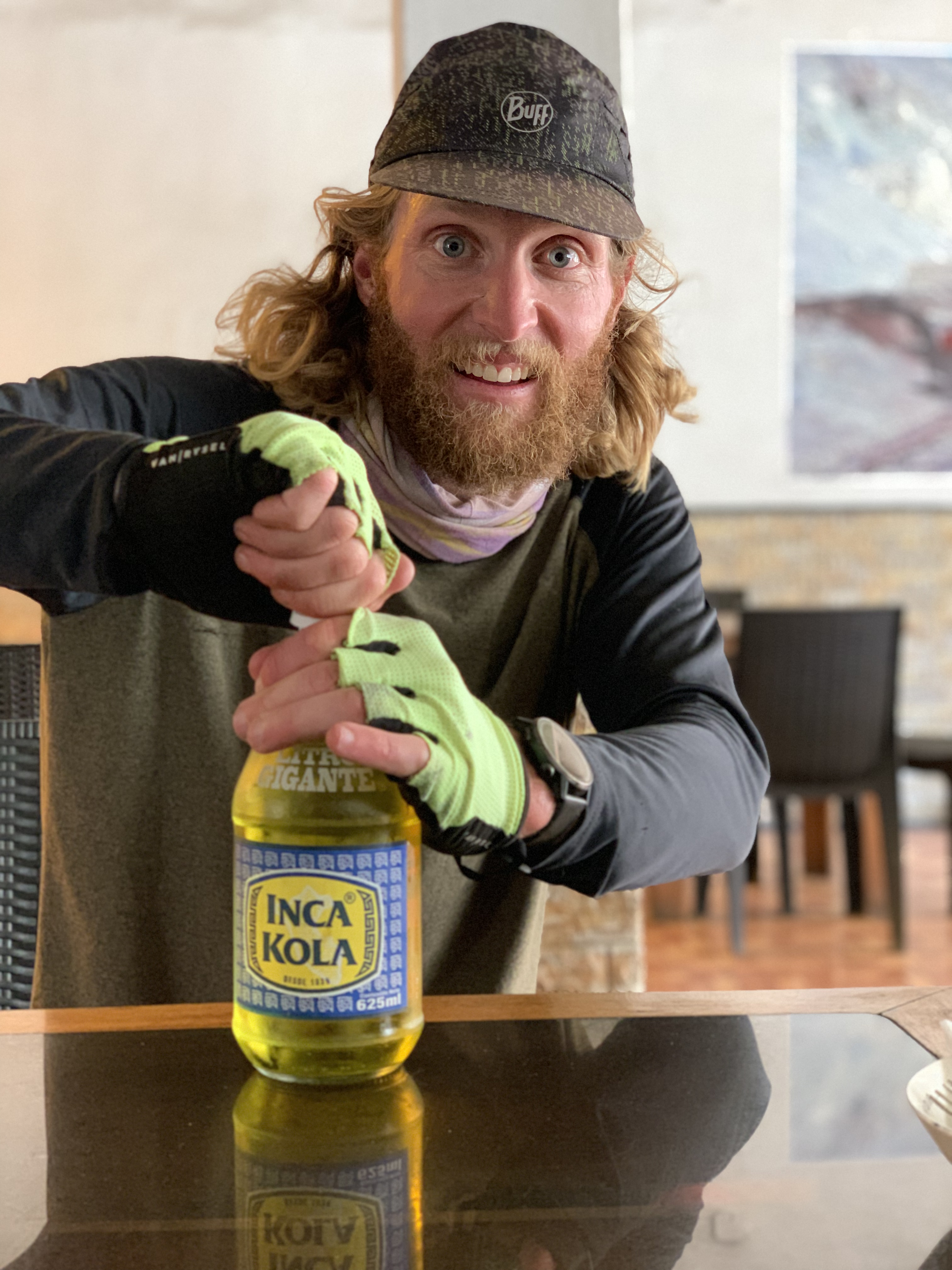
If I 99% agree that establishing ground rules helps hold fast to the teachings of an arduous path, even as its value is not always readily apparent; it’s because the 1% is lycra. The 1% is that little extra stretch that ensures flexibility precisely in those moments when the unyielding fabric of experience would otherwise rip at the crotch. Reality never ceases to take precedence whether or not you are running a parallel sub-program called ‘Throughism’. Reality never ceases to take precedence whether or not you are running a sub-program under that sub-program called ‘Off-road throughism’.
When cycling on a dirt road, for example, do you willingly seek out the worst possible line? Do you voluntarily align your wheels for the most unrideable section of the trail? Facetiousness aside; no, you don’t. The trick is to find the best possible line. In a nutshell, that is what mountain biking is all about. To avoid hitting the ground and generally acquit yourself with grace.
Now, if there is a narrow strip of cement running alongside the dirt road, would you ride it? What if your choice is between a cobblestone road and that strip of cement? What if riding that strip of pavement allows you to arrive before the storm hits? What if that strip of cement is a paved highway running parallel to the dirt road? What if that paved road deviates from the dirt road, but gets you to the same destination? What if it’s shorter? Or longer, for that matter? What if it’s a matter of safety to reach your destination sooner? What if it is to avoid, say, hypothermia or getting hit by lightning? And if the map has a 1% of unavoidable busy highways, do you catch a ride to maintain the purity of only riding off-road? And if you allow riding on highways, why not use them to your advantage? Why not use them to, say, maximize the good bits? What if skipping the bad bits allows you to squeeze in more good bits into a 3-month trip? More breathtaking landscapes? More life changing experiences? More countries?
Where do you draw the line? What are the parameters? Which will break the narrative of the trip, the feel? Which will undermine our identity? Which will alter the meaning of what we are trying to achieve?
Whether our train is on tracks or not, we are making a million different unconscious choices and concessions at every step along the way. So, I never saw the choice as apple or not apple. I have been taking small bites from the very beginning. Which means that when we argued over it, the discussion never reached any productive consensus because I was trying to confess over and over that the apple was already sorta half-eaten. Whereas Ceci was arguing for the holy wholeness of the apple, sight unseen. And I was arguing that if she would only turn the apple to see all the bite marks on the other side… and she was arguing that to touch the apple or in any way cast doubt on its integrity was in itself a sacrilege.
And somewhere in the back and forth, half-blasphemy, half-sacrosanctity, the apple fell. Sticky side down, of course. Which aside from being as powerful an argument that there isn’t a God, also went a long way in helping us towards a decision. Because, truth be told, if Ceci wanted to go back, it would have been fine by me. My goal was just to reach a point where if we returned, it wouldn’t be because the apple is holy. My goal was to find the answer to this question:
If the apple fell anyway, if there was no way to restore its sanctity regardless, then what difference an 8 hour bus ride back to the Peru Divide or an 18:30 bus ride south to Arequipa?
And the answer we reached was: algo especial. Algo especial is why we’re here, after all. And the south of Peru offered something special in the shape of different landscapes, different cultures, a possible escape to Bolivia and the possibility for slightly better weather. Possibly.
In short, between the sssisters and motherss and auntsss and grandmothersss and the conniving of yours truly, Eve; God ate her half of the apple. Yay for feminism!
And in case your wondering, since we’re in the business of feminising the bible: Adam is our bikes. Just along for the ride. Cast out from the Garden of Eden for the sin of following in Eve’s footsteps. Cast out to forever more till the ground beneath us.


Expedition
‘Tal vez 3 meses fue demasiado…’
Ladies and gentlemen, there you have it. Five words one number. The Ecuador article contained 8 painstakingly crafted sections and 15,500 words. This article contains 8 painstakingly crafted sections and 18,300 words. All told? 33,800 words. Thirty-three thousand words to Ceci’s… five and a number?
Why do I even bother? And the worst part is, Ceci herself probably didn’t know what she was about to say before the words fell out of her mouth.
‘Perhaps 3 months was too much…’
And yet, in five words and one number, she has done more to sum up our experience than me and my 10,000+ hours of writing. Maybe you had to be there. The look in her eyes when she says it, like she’s looking down the edge of a cliff into the very heart of darkness. But never mind how she looks, all dishevelled, two big red squares of sunburned skin on her forehead to match the gaps in her helmet, no shower in 4 days, the same clothes on for the last three… She’s salty and dirty and smelly… However! At that moment, she’s as beautiful as a burning bush to me, out of whose flaming, blistering mouth: a divine revelation. The holy truth of our trip. The heft and breadth of it. The long and short, the high and low. And while it might not exactly seem like the Ten Commandments to you, allow me to carve, in stone, the remarkable eloquence of such few words.


This is our 3rd 3-month trip. Which, quite apart from being a tongue-twister, is quite the leg-twister, too. By now, we are well-versed in their lifecycle. The initial adaptation, the apex of fitness, the point when our fitness matches our exhaustion exactly, the point when exhaustion outmatches our fitness and the final sickness that comes once the trip is over and once we allow ourselves to release 3 months worth of mental and physical discipline. The survival instinct is an extraordinary thing. And it takes its toll in a espectacular way.
And this is where this trip exceeds, in every respect, anything we’ve ever undertaken. Every single day is an expedition. Every day, we make multiple ascents into high-altitude conditions, high-mountain weather and while carrying all the gear that entails. Which, depending on how much water and supplies we need, comes in at about 35-40kg, including the bikes. Each.
By the time Ceci proclaimed her divine revelation, the back-to-backness of Northern Peru hit us so hard that we couldn’t fathom the why or how or when, much less the who and where. The Peruvian Andes chipped away at us in such subtle increments that we never stopped believing that we were the ones chipping away at them. We still do. In fact, not until I started running the numbers could I appreciate the craftiness of it. So here’s a quick rundown.
In 25 days, we managed to cycle 21, accumulating 1,425km with 31,022m of altitude gain. Our highest point for each day in Peru hovered between 3000m-4000m, for the first 7 days of cycling. Here is what the rest of the highest points look like, in kilometres above sea level: 4.7(4,700m)-4.1-4.6-4.5-3.1-4.2-4.9-4.2-4.8-3.6-4.9-4.8-4.9-4.2.
Cycle-tourism, cycle-travelling, bikepacking… To call this kind of locura anything else but cycling-alpinism, I think, would be to sell it short.
Quite apart from the altitude, this trip set an all-time record for its cycling-to-rest-day ratio. A ratio of 17:3 in Ecuador. With one rest day containing 12kms of cycling. As for northern Peru, 20:4. With one rest day containing 30kms of cycling.
On a day-to-day level, this trip also marked a complete departure from our usual 6am to 1-2pm cycling window; a format that freed our afternoons for exploration, creature comforts, discussions and assimilation. The Andean cycling tradition is all about using the whole entire day. Often requiring the full extent of our mental and physical energy, as well as problem-solving capabilities, just to reach our destination before nightfall (or not too long afterwards). Until our wheels hit the Ecuadoran mud, it had never occurred to us just how fresa our previous cycling trips had become. Just how Gucci (in comparison).
In Ecuador, we were still rising to the challenge of the Andes. And we were just about getting our water-skis under us when Peru happened. Pachamama, as boat captain, looks back once and sees us rising out of the water. So, she raises it up a notch. When Pachamama looks back again and sees us hanging on: she raises it up a notch. By the time we get shot at, we’ve lost a ski but we’re still smiling. By the food poisoning, we were dragging in the water, still unwilling to let go. Unwilling to even admit that we were being dragged in the water. When Pachamama looked back then, around Laguna 69, she saw that we’re still hanging on, and whether for our own good or not, she raised it up a notch. And so now, we’re drowning, getting pummelled by punishing amounts water. How far we make it now, is irrelevant. We aren’t waterskiing any more. And so we aren’t really waterskiers, either. Are we?
I’m sure the definition of what constitutes an expedition varies from person to person. But for me, this is it. It’s not having an off switch. It’s being on, all the time. It’s not knowing how long the drowning will go on for; it’s not knowing how much you can withstand. That’s what an expedition is to me. It is a question. It’s: How long can I last in the ON position? It’s: How long can I last without the possibility to switch OFF? It’s a give and take between what an experience requires of you and how much of you there is to give. And defining yourself by the limit you establish. Finding your own bounds within a boundless experience. Finding an answer to who you are.
And so, when Ceci says, ‘Tal vez 3 meses fue demasiado…’ you have to remember who Ceci is, to understand the profundity of such a declaration. Ceci’s passion knows no bounds. It gives her a resilience to discomfort and exhaustion and pain such as I’ve never once encountered in my life. There is no limit to how much of herself she can give. To the point of collapse. Over the last 6 years of such trips, of asking such questions of ourselves, I have never once heard anything even remotely near such a concession.
Three months were most 100% definitely too much. We were drowning out there. Isolate any day of the trip and you would have a worthy candidate for a once in a lifetime expedition. Align three months together and all there is left, eventually, is the will to survive. The worst that could happen redefined itself with every passing day. Built on itself with every passing day. Until it was no longer a matter of seeing the good in the bad or the luck in the bad luck. All we had to be optimistic about was being alive.
These 5 words and a number were, to my recollection, Ceci’s first concession to the fact that an experience can ask more than a person has to give. And when you hear me go on endlessly about humility and so forth, this is what I mean.
There is a profound sense of meaning to finding the outskirts of who you are, not only because it helps set new standards of what it can mean to be you, but because these outskirts also allow you to stop colouring wildly outside the lines. Not knowing how far you can stretch the very fabric of your potential is like being lost at sea. There is too much space there for conjecture. Too much space for pretences. Too much space for insecurity. For overthinking. For misplaced pride. For vainglory. We all reach blindly into the unknown. It’s what it means to be human. We reach to find the walls of who we are.
Only once we reach these walls and become familiar with them can we start to make from them a house. And then, from a house a home. Only with the knowledge of our outlines can we start to colour-in who we are with precision of craft and creativity. And only once we do so, can we possess the self-confidence necessary for humility.
Yes, self-confidence and humility. In my mind, the two are inexorably linked. And the reason this sounds counter-intuitive is because, in today’s world, we often conflate self-confidence with arrogance. Which, of course, is an antonym of humility. And it is very important, especially for athletes, to get this right. Arrogance is a symptom of insufficient knowledge about who we are and where our limits are, which in turn makes us paint wildly outside the lines.
At the other end of the spectrum, there is also a conflation between minimizing one’s own achievements and humility. To minimize one’s own achievement is to undermine the self-confidence necessary to uphold humility. Humility is to keep one’s achievements comfortably in one’s home. They might be glimpsed from the windows, but only a select few are welcomed in to interact with them. And that is enough.
With self-knowledge comes self-confidence and with self-confidence comes a separation of achievements from ego. Ego is the antithesis of humility. It is a big bad wolf that faces outwards; that seeks to protect the frailty of your little piggies or achievements. The stronger your inner house, the less it needs arrogance and/or self-depreciation techniques to protect it. And it is precisely these defensive techniques, arrogance and self-depreciation, that leave a hole in your self-esteem. A hole that always needs to be filled with the next training session, the next race, the trip.
Humility—awareness of the limits of your potential—grants you a solid foundation to build on and solid walls to house who you are. It gives you the self-confidence to go out there and try something new, to learn, to experiment. If you reach new limits, you expand. If you fail in the attempt, you reinforce your self-knowledge. Either way you always have a home to return to. Either way you grow as a person.
‘Tal vez 3 meses fue demasiado…’ is honesty. Is self-knowledge. Is the separation of the inversed big bad wolf of the Ego and the little pigs of her achievement. It is Ceci colouring-in who she is, and to me there is nothing more noble and beautiful in the whole wide world. Never mind the little red squares of sunburned skin on her forehead.


Ceci vs Etienne
We have diametrically opposed ways of being, Ceci & I. If you remove the watchface of our common goals, the mechanisms underneath could not be more apples and oranges. Just exactly how much of this reveals itself to the outside world, is impossible for me to know. So, here’s a magnifying glass, here’s a pair of tweezers, let’s pick apart the mechanism together, let’s lay bare the cogs of Ceci & Etienne, let’s play a little who’s who.
To begin with, the minerals at the heart of our mechanisms oscillate at wildly distinct frequencies. It will perhaps come as no surprise to anyone who reads this that Ceci is more vamos vamos vamos, go go go, than I am. Now, on a normal day, this variation in frequency might even-out to a variation of a few milliseconds an hour. But to travel through the Andes on a bicycle is to extrapolate even the tiniest of insignificances to its most extreme expression.
One of the biggest lessons which the Andes have imparted is that motivation is energy. Once all other sources of energy have become entirely depleted, the extra reserves that kept us going were of entirely distinct natures.
What Ceci values about life is out there, in the world, waiting to be discovered. Which, when you factor in the wonders we cycled through every day, means that her motivation is also out there, waiting to be discovered. Her motivation to move forward is being constantly replenished, which gives her access to a source of energy that goes beyond normal reserves. Which is actually deeply meaningful in a way, because this means that the wonders of Ecuador and Peru are energy for Ceci.
Okay, I know… Here’s me being all spiritual again. But consider this. Adrenaline plays a huge role in helping our bodies access energy. After 9-10-11 hours of cycling through the Andes, adrenaline is crucial in keeping us going. And so, when you consider that adrenaline is derived from dopamine and that dopamine is a reward for goal completion and that goal completion is the prime motivational factor for this trip; then saying that motivation is energy might not exactly be as shamanic as it sounds. And if motivation is energy, then, if what motivates you is fauna, flora, landscapes, kilometres, vertical gain, ruins of an ancient civilisation… then the Andes are distilled and highly renewable energy. For Ceci.
Without the help of our absolutely bananas cycling/rest ratio, I might never have realised this fundamental difference at the core of who we are. If what Ceci values about life, what recharges her watch batteries, is outside herself; what I value about the world is the exact opposite: how it lives inside me. How the act of living, the experiences we gather, the lessons we learn… interact with the inner biosphere of who I am intellectually and emotionally. Which is to say: creatively. Which makes days-off quintessential to the good functioning of my inner mechanism. Not only to have a rested and oxygenised brain with which to process all that we live through in a day, a week, a month, a trip; but to allow time for reflection, contemplation, assimilation, imagination…
The greatest and most bottomless source of meaning for me is creativity. It is what keeps me going, it is what helps me tap into motivation, it is, to me, energy. And so, in a way, the balance between experience and creativity, the balance between days on and days off the bike, affects me in a way that it never does Ceci.
Especially once you consider that what Ceci values about the world is its endless capacity to surprise and amaze her, the near-infinite experiences that life can offer. Ceci devours experiences, fully and utterly in the moment. Her openness and willingness and gameness are something to behold. To live is her end goal. And this zest, this… appetite for life possesses a seemingly infinite capacity to expand. And the more time we spend travelling without rest, the more this capacity to expand becomes a necessity to expand. However, an expanding void knows an expanding hunger. So, often it takes a me for Ceci to accept the painful remedy of starvation. To reset the void to a reasonable size.
I, on the other hand, absorb. I am a sponge. And so, I saturate. When we reached the lowest point just before Lima, neither of us could remember how many cycling days in a row or how many days without a shower or even what order the days came in or where each day started and ended. The saturation was such that the experience was losing definition, was leaking away unassimilated. And our immediate exhaustion and despair was threatening to bleed over and contaminate the moments of elation and awe.
In short, I needed a little emotional and intellectual squeeze. But when a squeeze is a creative pursuit, what’s one day off? Such brain fog and experiential entanglement were beyond the mighty power of even caffeine and coca leaves to clear and disentangle. Such tasks were still waay too high on the Maslow pyramid to be effectively performed.
And so, Lima. Lima and the satiation of basic needs. The fixing of bike and body. And even here, our diametrically opposed mechanisms reveal themselves. Down to our choice of a meal, we can’t escape revealing our respective natures.
For me, routine is a tool for the establishment of the foundational layers of Maslow’s hierarchy of needs in an efficient and effective manner. It’s a long climb for so few days. From rock bottom, up through the basic physiological (food, water, warmth, rest) and safety needs; up through love and belonging; up through esteem; to finally arrive at the topmost tier: self-actualisation. Where creativity can arise. Where I can recharge in a meaningful way. Where I can, at last, open the pandora’s box of our adventures and explore and assimilate and restore creative colour to the dense knot of experience therein.
Which is a fancy way of saying, I eat the same thing every day. It’s true. I am an I-know-what-I-like person. I know when I find it and when I find something that satisfies me fully, I repeat. I don’t wonder if I could do better. ‘Fear of missing out’ (FOMO) is not a modality my mind computes. I don’t buy it.
I run a little program that’s called Cittoj. Comparison is the thief of joy. It’s swift, takes virtually no time to boot and kicks envy in the shin. Without comparison, you learn to value what you have. Value is not inherent to anything. It is not a virtue. It is a human process. You can discover value, you can grant value. And if you explore what you value, you eventually find meaning.
Fomo is the art of investing more value towards what others are doing than towards your own experience. And, value being a finite resource, when the time comes to build your own path towards meaning, you are left empty-handed. The catch-22 is that meaning is the best defence against FOMO. Meaning makes you untouchable. It is the unique expression of your unique potential. Whether that expression is to be a teibolera (a table dancer (my favourite word in espanish)) or to be an astronaut. It needs to resonate.
Follow what you value and the resulting satisfaction will automatically release the dopamine necessary to reinforce and incentivise the behaviour. It’s an upwards spiral. An upwards spiral! Think about it. Why you should ever give this precious self-bettering elixir away is a mystery to me. Why you should waste an automatic incentive response on someone else is impossible to conceive. FOMO depletes it. Get away from it! Those aren’t your emotions! Don’t touch! Emotions are half of who you are. And you’re throwing them away? For the net effect of a little blue thumbs up rather than personal growth and self-actualisation?
Here’s my bid for an honorary psychology degree. If you want to solve today’s attention deficit, just teach Attention Economics in schools. Attention is the most powerful currency of our time. Save it. Value it. Give it to your loved ones, to your kids.
Give it away for free and behold the monsters you create. Do you think it matters to dictator-apprentices whether you feel indignation or admiration towards them? They are attention leeches. And in a world where attention is currency, they grow fat. Period. While we discredit the rest for being attention-poor.
What you give your attention to is what you value. Focus on your own experience and you’ll find that even a lesser experience is greater for being fully experienced and entirely yours.
Which is an extremely roundabout way of saying: yes, I eat the same thing at the same restaurant, every day… if Ceci lets me. I like to sit at the same table and say ‘Si, por favor!’ when the waiter asks whether I want ‘The usual’. Even after just one afternoon in one place, I have established my rituals. A rest day, for me, is only effective if I get my fundamentals right. It’s the only way I can relax enough to focus on the higher pursuits of spinning a web of meaning from the knotted thread of our experiences.
Meanwhile, Ceci sits next to me, fuming with embarrassment.
Her yearning to experience everything there is to experience is severely limited by a rest day. It disappoints her. It insults her a little. It aggrieves her. It’s a concession she is making. To me. So she performs her little self-sabotages. Give her the best thing in the world to eat and she’ll want to try something else next time. Just to get her dose of gambling with fate.
And this same difference in mechanisms carries over to our way of travelling. Ceci wants to never miss a single flower, not a single stone or scenic view. Whereas, at this point in the trip, I believe it’s safe to say that we’re full up on the Andes, on scenic views, flowers and stones.
‘Pero como sabes?’ says Ceci, always. And of course, she’s right. There is no way I can know. But what I can and do know is that what we’re fully empty of is rest, assimilation, perception, reflection; gratification for our delay. Things that, if you ask Ceci, occur naturally (like when your bike breaks down), so why actively seek them?
Where I think we least converge is certainly our coping mechanisms. Allow me the short anecdote of the Gringo laundry bag and then we’ll quit for the day.
On a day like any other, we sent our laundry off and it came back with the word, or half-word, ‘GRIN’ on it. And because what recharges Ceci’s batteries are the world without and its wonders, where she stores the toxic by-product is inside. She compresses it. Represses it. Forgets about it. And then, once in a while a laundry bag comes back with the half of the word Gringo on it, and that hardened ball of condensed emotions cracks a little bit. And the first time this happened, she laughed until tears filled her eyes. Which, so far might not seem cuckoo to you, but since I thereafter used the ‘Grin’ bag to kept my shoes from getting wet, the bag made it’s reappearance from time to time. And by the third, Ceci’s condensed ball of hurt imploded. And she lost her mind quite cinematically. The stuff of telenovelas. I must have been unpacking my shoes when she caught sight of the bag and started giggling. And I started giggling because the joke was worn so thin by now that you could almost see through it back to the time when it was actually funny. Anyway, we had a little moment. Which ended in a hug. And here, the floodgates vanished. They just fssshhip! disappeared. And now, Ceci officially is crying. Like in the movies. She laughed herself into weeping. The pure essential oil of her hurt just came flooding out her eyes. Weeks and months of the stuff, bottled up. And the ‘Grin’ bag by some entirely inexplicable lunacy slipped itself under the bottle cap like a teaspoon of baking soda and… voilà! Volcano eruption.

Anyway, I’m a few years away from my last school science project, but you get the picture. My thing is, I swear under my breath. In French. So you know I’m not messing around. And I do so at least a few times a day every day. At Pachamama. At the Andes. At Peru. At the wind. At my legs. At my bike. You name it. Not in any vicious way or anything. Just like you would say, ‘Why you little…!’ at someone who played a prank on you. You know… with a smile in the corner of your mouth. Mostly with a smile, anyway. And every time I do, a bit of the pressure comes out and propels me forward.
And besides, alone time is my release. Which I get every night, while Ceci is snoring. Ceci who gets her release when we call home. Through our friends and family’s emotions at what we’re experiencing, she finds a permission or a window into exploring her own.
On most days, a good shower is enough for me. It tells me I’m safe, tells me I’m done, that the day’s over. Meanwhile, Ceci never wants to admit it’s over. So she doesn’t shower, she keeps her shoes on in bed, she doesn’t brush her teeth and every night she tells me I’ll wake up in 5minutes, I just need to close my eyes. And then sleeps till morning.
So, there. If you see life through the lens of what recharges and what drains soul batteries, we live on different cosmic planes. Luckily, what unites us, what makes our watches tick, are the good times we keep. Awww…. so cute. See you in Southern Peru and Bolivia!
Northern Peru in numbers:
Total Kilometres: 1,425km
Total Cumulative Uphill: 31,022m
Total Cycling days: 21
Total days: 25
Total hours on the bike: 118
Longest day on the bike: 9 hours 13 minutes
Longest day total: 11 hours 35 minutes
Most kilometres in a day: 140km
Most uphill in a day: 3,005m
Highest point: 4,880m
 LifeAthlon
Gracias muchas. ________________________________
LikeLiked by 1 person
Fantastic read
LikeLike